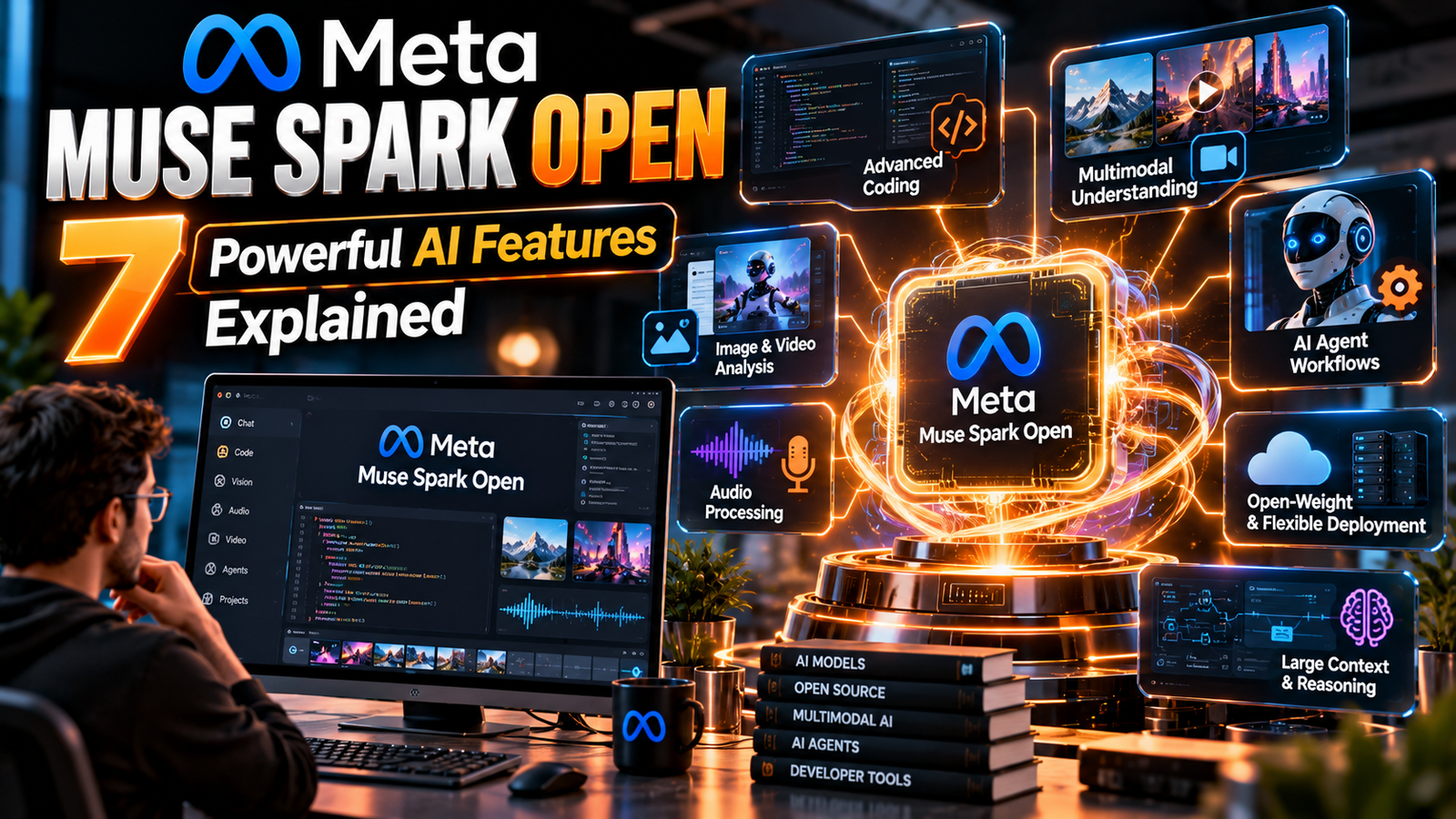
Artificial intelligence is moving beyond simple chatbots toward systems that can understand different types of information, write code, and complete multi-step tasks. Meta’s latest open-weight model is part of this shift.
Meta Muse Spark Open is an open-weight AI model announced on October 15, 2026. Developed by Meta Superintelligence Labs, it is designed for coding, reasoning, and agent-based workflows. The model accepts text, images, video, and audio as input, and Meta has released its weights for developers who want to customize or run it in their own environments.
This guide explains the model’s features, architecture, use cases, hardware requirements, licensing, advantages, limitations, and how developers can evaluate it for their projects.
What Is Meta Muse Spark Open?
Meta Muse Spark Open is an open-weight version of Meta’s Muse Spark model family. It is built to support AI applications that need more than a short conversational response.
For example, an AI coding agent may need to examine a large project, understand the existing code, plan a change, make edits, and check whether the result works. A multimodal agent may need to interpret screenshots, documents, or video alongside written instructions.
The model is designed for these kinds of workflows.
It is important to understand the term open-weight. It means the model’s trained weights are available for download, allowing developers to run or adapt the model under its license. It does not necessarily mean every part of the training process, dataset, or development pipeline is publicly available.
Meta says the model is available through its model resources and selected hosted inference providers. Developers can choose between managing their own infrastructure and using a provider that handles the model’s computing requirements.
8 Key Features of Meta Muse Spark Open
The following features explain what makes the model notable. They are based on Meta’s published specifications and release information; real-world results can vary with the task and implementation.
1. Open-Weight Model Access
One of the most important aspects of Meta Muse Spark Open is that developers can obtain its model weights.
This gives technical teams more flexibility than using a model that is available only through a closed API. Depending on the license and deployment setup, teams can examine the model’s behavior, run it on their infrastructure, or adapt it for specific applications.
Open-weight access may be useful for organizations that want more control over deployment and data handling. However, downloading a model does not automatically make it easy or inexpensive to run. Hardware capacity, software compatibility, and maintenance all matter.
2. Large-Scale Sparse Model Architecture
Meta reports that the model has 816 billion total parameters, with approximately 42 billion active parameters per token. It uses a sparse mixture-of-experts architecture, which routes each token through selected portions of the model rather than activating every parameter for every token.
This design aims to balance model capacity with the amount of computation used for an individual token.
However, active parameters and total parameters are different measurements. The fact that only a portion of the parameters are active for each token does not mean a computer can ignore the full model’s storage requirements. A deployment still needs enough memory to load the selected checkpoint and supporting components.
3. Multimodal Input Support
Meta Muse Spark Open supports multiple input types, including:
-
Text prompts and instructions.
-
Images and screenshots.
-
Video clips.
-
Audio input.
This makes the model relevant to projects where information is not limited to written text.
For example, a developer could design an application that asks an AI system to interpret a screenshot or summarize information from a supported video input.
The model’s published specification describes text output, so users should not assume it directly generates finished images, videos, or audio files simply because it can understand those inputs.
4. Long Context Window
Meta lists a context window of approximately 1,048,576 tokens, commonly described as a one-million-token context window.
A context window determines how much information a model can consider in a single interaction, subject to the deployment and request configuration.
A large context window can be useful for:
-
Reviewing extensive technical documentation.
-
Understanding large code repositories.
-
Analyzing long project instructions.
-
Working with multiple related documents.
It does not guarantee that every detail within a large input will be interpreted perfectly. Developers should still test retrieval, accuracy, and context management for their particular workload.
Read more: Fashionisk.com: 7 Essential Benefits and Key Insights for Fashion Lovers in 2026
5. Advanced Coding and Software Engineering
Meta positions the model for coding and long-horizon agentic work.
A coding workflow might involve reading existing files, identifying a bug, planning a fix, editing several files, and running tests. The model is intended to help coordinate these stages.
For software teams, this could support code review, development assistance, and automated project workflows.
The quality of results will depend on the model, available tools, repository structure, and the tests used to validate its work. A generated code change should not be treated as correct merely because the model completed the task.
6. Multi-Step AI Agent Workflows
Meta Muse Spark Open is designed to support agents that plan and perform sequences of actions.
An agent may need to:
-
Understand a user’s objective.
-
Break the objective into smaller tasks.
-
Use available tools.
-
Review intermediate results.
-
Correct mistakes and complete the workflow.
Meta’s developer information describes the model as suitable for agentic work, including workflows that use tools and handle complex tasks over multiple steps.
The model does not automatically have access to every tool or application. Developers need to provide integrations, define permissions, and decide which actions require human approval.
7. Local and Hosted Deployment Options
Developers can use Meta Muse Spark Open in two broad ways.
Self-hosted deployment: The team downloads the model checkpoint and runs it on its own infrastructure using a compatible inference system.
Hosted inference: The team sends requests to a supported provider that manages the underlying computing environment.
Meta’s announcement lists hosted availability through providers including Baseten, Fireworks AI, Groq, Modal, Nebius, OpenRouter, and Together AI. Provider availability and model configuration may differ.
These deployment options allow developers to evaluate the trade-off between infrastructure control and operational convenience.
8. Customization and Fine-Tuning Potential
Because the weights are available under Meta’s model license, developers can explore customization for their own use cases.
Potential activities include:
-
Testing different prompting strategies.
-
Evaluating the model on domain-specific tasks.
-
Adapting the model with supported tuning methods.
-
Building specialized coding or document-processing workflows.
Meta points developers toward tools such as PyTorch’s TorchTitan for model tuning and MLX for Apple silicon workflows. The practical options depend on the checkpoint, available hardware, and software compatibility.
Customization is a technical project, not a one-click guarantee of better results. Teams should compare the adapted model with the original using relevant evaluation tasks.
How Meta Muse Spark Open Works
A practical way to understand Meta Muse Spark Open is to look at the steps involved in using it inside an application.
Step 1: Define the task
First, decide what the AI system should accomplish.
For example, a development team might want to build an agent that reviews a codebase and suggests improvements. A research team might want a model to analyze documents and answer questions about them.
The objective should be clear enough to evaluate the result.
Step 2: Choose a deployment method
The team decides whether to download and run the model itself or use a hosted inference provider.
Self-hosting offers greater control over the computing environment, while hosted inference can reduce the amount of infrastructure a team needs to manage directly.
Step 3: Provide the relevant information
The application supplies the model with the appropriate prompt and supported input.
Depending on the workflow, that input might contain source code, text, screenshots, documents, or video.
Developers should avoid sending unnecessary private information and should establish appropriate data-handling policies.
Step 4: Connect tools and define permissions
For an agentic workflow, the model may need access to tools such as a code editor, test runner, or document-processing system.
The application must define what the agent is permitted to do. For instance, an agent may be allowed to review code but require approval before modifying a production system.
Step 5: Evaluate the output
The final stage is checking whether the model completed the task accurately.
For a coding agent, this may involve running tests and reviewing the changes. For a document-analysis workflow, it may involve checking whether the answer is supported by the original material.
A good implementation measures accuracy, consistency, latency, and cost rather than assuming that a successful response means the task was completed correctly.
Hardware Requirements: Can You Run It Locally?
The hardware question is particularly important because Meta Muse Spark Open is a large model.
Meta’s documentation provides different checkpoint formats and deployment guidance. The full model has 816 billion total parameters, so the storage and memory requirements are substantial. The sparse architecture reduces active computation per token, but it does not remove the need to load the full model weights for a conventional deployment.
What about Apple Mac Studio?
Meta has specifically demonstrated the model running on two Apple M5 Ultra Mac Studios with the MLX framework. This is a notable demonstration of local inference, but it should not be interpreted as proof that a single ordinary desktop computer can run the full model.
The actual requirements depend on:
-
The checkpoint format.
-
Available memory and accelerator hardware.
-
The inference framework.
-
Quantization and other supported optimizations.
-
The desired response speed and workload.
Before purchasing hardware, consult the official deployment documentation and calculate the complete memory requirements for the selected checkpoint.
Meta Muse Spark Open vs. Hosted AI Models
Choosing between an open-weight model and a hosted model depends on what the developer needs.
| Consideration | Open-weight deployment | Hosted AI model |
|---|---|---|
| Infrastructure | Managed by the developer or hosting provider | Managed by the model provider |
| Deployment control | More control over the runtime environment | Depends on provider options |
| Initial setup | Can require substantial technical work | Usually simpler to start |
| Data handling | Can be configured for local processing | Depends on provider’s data policies |
| Maintenance | Developer manages updates and operations | Provider manages much of the infrastructure |
Meta Muse Spark Open is attractive for teams that want control over deployment or need to customize the model. A hosted service may be more practical for teams that do not want to manage large-scale infrastructure.
Neither approach is automatically better for every project.
Benefits of Meta Muse Spark Open
Greater deployment flexibility
Open-weight access gives developers more choices about where to run the model and how to integrate it into their applications.
This may be important for teams with specific infrastructure, privacy, or operational requirements.
Potential for specialized applications
The model’s coding, multimodal, and agentic capabilities create opportunities for applications that handle complex workflows.
Examples include software development assistance, document analysis, and systems that interpret visual information.
More control over evaluation
A team operating the model itself can evaluate its behavior in a controlled environment and compare different deployment configurations.
This can be useful when a project needs specific performance or data-handling requirements.
Limitations and Risks to Consider
High computing requirements
The model’s scale means local deployment is not suitable for every developer or organization.
The total weight footprint, memory needs, and inference speed should be considered before making infrastructure decisions.
Open weights do not mean unrestricted use
Meta releases the model under its Muse Model License, which includes limited commercial terms. Developers should read the current license to determine whether their intended use is permitted.
Do not assume that open-weight access means the model is public domain or that every commercial application is allowed without conditions.
AI-generated output needs verification
A model may produce incorrect code, misinterpret an image, or reach an unsupported conclusion.
For important workflows, teams should use appropriate tests, review processes, and human oversight.
Security and privacy require additional controls
Running a model locally can provide greater control over data handling, but it does not automatically make an application secure.
Developers still need to manage access permissions, protect credentials, and review what information is sent to external tools or services.
Read more: Why Japan’s Biggest Messaging App Line Decided to Create Its Own Crypto
Frequently Asked Questions
1. What is Meta Muse Spark Open?
Meta Muse Spark Open is Meta’s open-weight multimodal AI model, designed for coding, reasoning, and multi-step AI-agent workflows.
2. Is Meta Muse Spark Open free?
Meta has released the model weights under its Muse Model License, which allows many developers to use them without a model-access fee. However, infrastructure, hosted inference, and commercial use conditions may involve costs or restrictions.
3. Can Meta Muse Spark Open run on a regular computer?
The model is large and requires substantial computing resources. Local deployment depends on the selected checkpoint and hardware. Meta has demonstrated it on two Apple M5 Ultra Mac Studios, but that does not establish compatibility with ordinary consumer computers.
4. Does Meta Muse Spark Open support images and videos?
Yes. Meta lists text, image, video, and audio as supported input types. Its published specification describes text output, so direct media generation should not be assumed.
5. Can developers customize Meta Muse Spark Open?
Developers can explore customization and supported tuning methods under the model’s license. The practical process depends on the checkpoint, available hardware, and software tools.
Where to Get Meta Muse Spark Open
For the latest model specifications, downloads, license information, and deployment guidance, use these official resources:
-
Meta AI Research announcement — announcement, capabilities, and model details.
-
Meta Developer documentation — deployment options and technical specifications.
-
Get the model — checkpoint information and download guidance.
-
Meta Muse Spark Open on Hugging Face — model collection and available weights.
Conclusion: Is Meta Muse Spark Open Worth Exploring?
Meta Muse Spark Open is an important development for teams interested in open-weight AI models, especially those working on coding assistants, multimodal applications, and AI agents.
Its major strengths are its large context window, multimodal input support, coding focus, and flexible deployment options. Developers can investigate the weights, evaluate the model in their own environments, and potentially customize it for specialized tasks.
However, its scale introduces practical challenges. Hardware requirements, inference costs, software compatibility, licensing, and output reliability all need careful consideration.
For developers with the necessary technical resources, Meta Muse Spark Open is worth evaluating through a small, controlled project before committing to a larger deployment. The best decision will come from testing it against the actual requirements of the application rather than relying only on published specifications.
