Introduction: When a Strange Label Needs Context
Digital design is filled with filenames, asset names, project codes, and technical labels that look meaningful but do not explain themselves. A phrase such as 1.5f8-p1uzt texture can therefore raise several questions. Is it the name of a texture file, an internal project identifier, a downloadable asset, a material reference, or simply a label created by a particular platform?
The safest starting point is not to invent a definition. Instead, treat 1.5f8-p1uzt texture as a searchable identifier whose meaning should be established from the environment where it appears. This approach is especially useful when the label comes from a design library, software project, online asset collection, documentation page, or unfamiliar file.
When researching 1.5f8-p1uzt texture, the surrounding context can be more informative than the unusual code itself. A reliable investigation should therefore focus on evidence rather than assumptions.
This guide presents a new, practical research structure. Rather than assuming what the term means, it shows how to investigate it, evaluate a related texture, organize its technical details, and decide whether it is suitable for a creative workflow.
1. Start With the Evidence Around the Name
A short identifier rarely provides enough information on its own. If you encounter 1.5f8-p1uzt texture on a webpage, inside a folder, or in a software interface, first record the surrounding information.
Look at the page title, section heading, filename, file extension, neighboring assets, download description, and any available documentation. The surrounding words can reveal whether the item belongs to a game-development project, 3D workflow, graphic-design collection, web resource, or another environment.
For 1.5f8-p1uzt texture, do not treat the label itself as proof of origin or purpose. A random-looking code may be generated automatically, while a human-created name may use an internal convention that is meaningful only to the original creator.
2. Separate the Identifier From the Texture
The word “texture” has a broad role in digital production. It can describe an image or mapped visual resource used to give a surface color, pattern, roughness, detail, or another visual characteristic.
That does not automatically tell us what 1.5f8-p1uzt texture specifically represents. The identifier and the asset should be examined separately.
When examining 1.5f8-p1uzt texture, first establish what the name points to. Then inspect the actual resource. If it is an image, examine dimensions, format, visual content, transparency, and quality. If it is connected to a material or 3D object, investigate how the asset is used within that system.
This separation prevents a common research mistake: assigning technical properties to a label before confirming that those properties belong to the underlying asset.
3. Build a Small Asset Profile
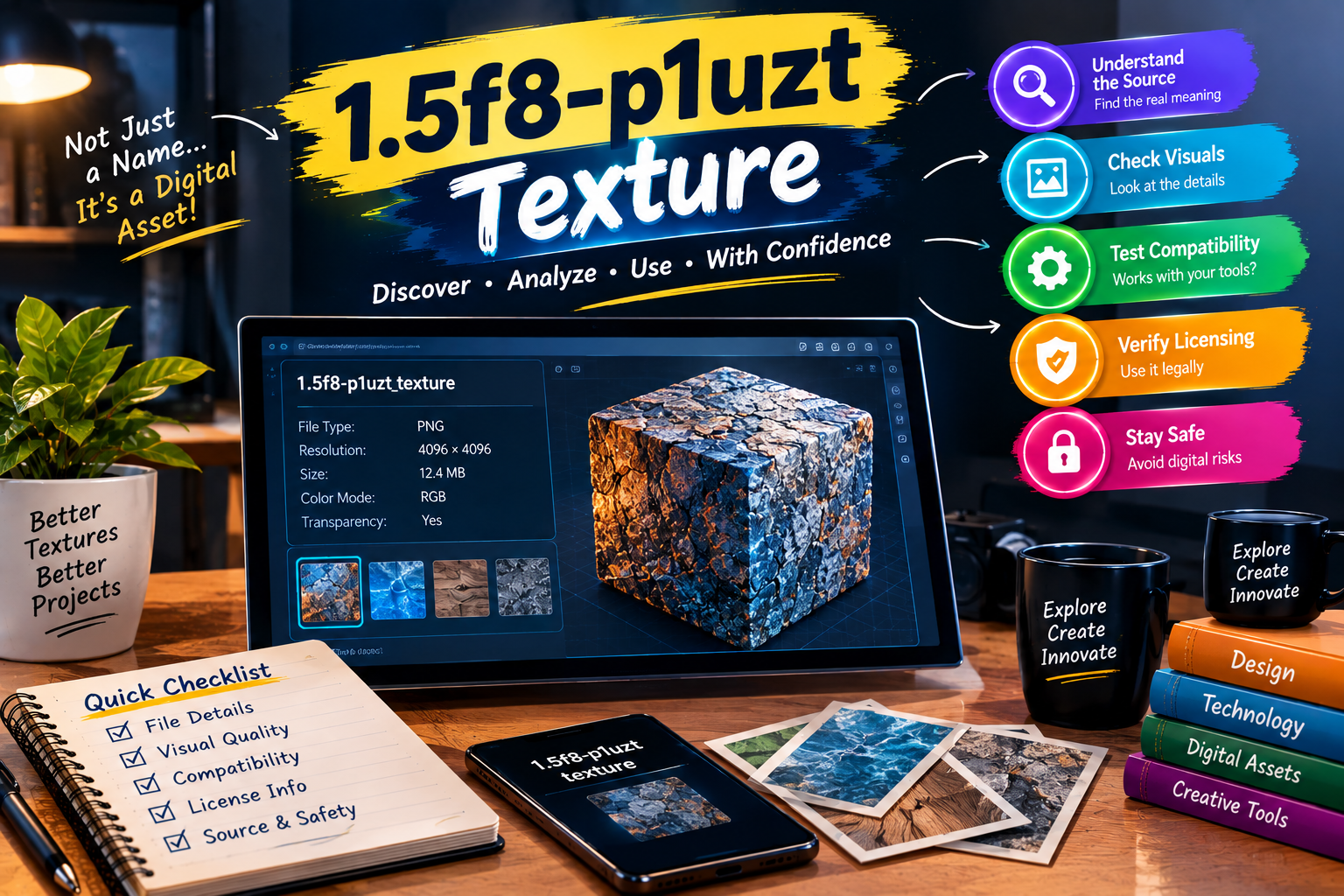
A useful way to investigate an unfamiliar resource is to create a compact profile. For 1.5f8-p1uzt texture, the profile might include:
- Name or identifier
- File type
- File size
- Pixel dimensions
- Color mode
- Transparency support
- Source or location
- Associated software
- Intended use
- License information
- Modification history
- Compatibility notes
You do not need every field for every project. The purpose is to create a repeatable method.
For example, if the asset is a PNG, that tells you something about the file container, but not necessarily about how the texture should be used. If it is a JPEG, compression may affect fine details. If it is part of a larger material package, the file extension alone may be insufficient to understand its function.
A profile for 1.5f8-p1uzt texture can also make future comparisons easier because you have documented the same categories of information each time.
Read more: About software wuvdbugflox: 11 Powerful Ways to Understand This Unusual Software Topic
4. Examine the Visual Characteristics
Once the resource has been located, inspect what it actually looks like. A texture can be flat, patterned, photographic, procedural-looking, stylized, abstract, or designed to imitate a physical surface.
When evaluating 1.5f8-p1uzt texture, consider the visual questions that matter to your project:
Pattern and Repetition
Does the design repeat cleanly? Repeating assets are useful when a surface must cover a larger area without obvious seams.
Detail Level
Are edges, small features, and surface marks clearly defined? Detail can matter differently depending on whether the asset will appear close to a camera or at a small size.
For 1.5f8-p1uzt texture, detail should always be judged against the intended viewing distance and final output rather than by file size alone.
Contrast
Strong contrast may attract attention, while subtle contrast can produce a quieter surface. The appropriate balance depends on the surrounding design.
Color Behavior
Check whether the colors remain suitable after resizing, compression, conversion, or placement inside the target software.
Visual inspection does not replace technical testing, but it provides an important first layer of quality control.
5. Investigate How the Asset Is Meant to Be Used
An unfamiliar texture becomes easier to understand when you identify the workflow around it. Ask where 1.5f8-p1uzt texture is expected to appear.
It could potentially be used as a simple graphic, a surface image, a reference asset, or a component in a more complex material workflow. However, the actual use should be confirmed through the source rather than guessed from the name.
Check documentation, screenshots, examples, project folders, metadata, or software instructions. If the original page provides an explanation, prioritize that information over assumptions based on the identifier.
For 1.5f8-p1uzt texture, context becomes especially valuable when the same visual resource could serve different purposes depending on whether it is used for a website, presentation, 3D scene, game environment, concept artwork, or another creative project.
6. Test Compatibility Before You Commit
A visually attractive asset may still be inconvenient if it does not fit the technical requirements of your workflow.
For 1.5f8-p1uzt texture, compatibility should be checked against the software and output requirements of the project. Consider the supported file formats, maximum dimensions, color handling, transparency requirements, import settings, and performance constraints.
If you are working with a 3D application, also check whether the asset is expected to be connected to a particular material channel. If you are using it in a design application, verify that the file imports correctly and retains the expected appearance.
A small test project is often better than discovering a compatibility problem after an entire scene or design has been completed.
For 1.5f8-p1uzt texture, testing a duplicate or temporary copy can also protect the original asset from unnecessary edits.
7. Check Quality Without Relying on Marketing Words
Terms such as “premium,” “ultra,” or “high quality” do not provide enough technical information. Quality should be evaluated through measurable or observable characteristics.
For 1.5f8-p1uzt texture, inspect resolution, clarity, compression artifacts, color consistency, edge behavior, and performance in the intended environment.
A very large file is not automatically better. Higher resolution can be useful when a surface is viewed closely, but excessive resolution may increase storage and processing requirements without producing a visible benefit.
Likewise, a smaller asset may be perfectly adequate for a background, thumbnail, mobile interface, or other low-detail application. Quality is therefore relative to the project’s requirements.
When comparing 1.5f8-p1uzt texture with other assets, use the same evaluation criteria so that the comparison remains practical rather than subjective.
8. Verify Source, Licensing, and Trust
Technical suitability is only part of responsible asset use. You should also determine where the resource came from and what permissions apply.
If 1.5f8-p1uzt texture is available through a website or asset repository, look for an explicit license, usage terms, creator information, and restrictions on commercial or modified use.
Do not assume that an asset is free to reuse simply because it can be viewed or downloaded. Some resources may require attribution, payment, registration, or permission.
Source verification also matters for security. Unknown files can carry risks, especially when they are bundled with installers, scripts, executable content, or unfamiliar archives. Keep your operating system and security tools updated, and avoid opening unexpected files simply because their names appear relevant.
For 1.5f8-p1uzt texture, a trustworthy source should provide enough information to understand what the asset is and under what conditions it can be used.
9. Create a Repeatable Research Workflow
The most useful result of investigating 1.5f8-p1uzt texture is not just a one-time answer. It is a method you can reuse for other unfamiliar assets.
A practical workflow can look like this:
Step One: Capture the Original Context
Save the page, folder path, screenshot, or project location where the term was found.
Step Two: Identify the Underlying Asset
Determine whether the label points to an image, material, package, reference, or another type of resource.
When dealing with 1.5f8-p1uzt texture, identifying the actual underlying file is more useful than trying to decode every character in the name.
Step Three: Record Technical Details
Document file type, dimensions, size, transparency, and other properties that matter to the project.
Step Four: Inspect the Visual Result
Look for repetition, artifacts, contrast, clarity, and other characteristics relevant to the intended use.
For 1.5f8-p1uzt texture, this step can reveal practical strengths or weaknesses that are not visible from the filename.
Step Five: Test Compatibility
Import a copy into the target application and confirm that it behaves as expected.
Step Six: Verify Permission
Check the original license and any restrictions before publication or commercial use.
Step Seven: Keep Evidence
Save important source information so you can explain where the asset came from later.
This workflow is simple enough for beginners and structured enough to support professional asset management.
Common Mistakes to Avoid
Researching an unfamiliar digital label can go wrong in several predictable ways.
Mistake 1: Treating the Code as a Definition
A strange identifier may look technical, but its appearance does not prove what it means. The same principle applies to 1.5f8-p1uzt texture: the name alone cannot establish the asset’s exact purpose.
Mistake 2: Confusing a Filename With a File Type
A filename can contain descriptive words while the actual extension determines the basic file format.
Mistake 3: Assuming Compatibility
An asset that works in one application may require conversion, configuration, or a different workflow elsewhere.
Mistake 4: Ignoring Licensing
Creative availability is not the same as permission to reuse.
Mistake 5: Evaluating Only by Appearance
An attractive preview does not reveal every technical limitation.
A Practical Decision Framework
After your investigation, you can classify the resource into one of three practical states.
For 1.5f8-p1uzt texture, the framework should focus on evidence rather than assumptions.
Ready: You know what the asset is, where it came from, how it works, and what permissions apply.
Needs testing: The source seems relevant, but compatibility, performance, or visual behavior still needs confirmation.
Needs more evidence: The identifier is visible, but the underlying resource or authoritative documentation has not been established.
This framework avoids premature conclusions and makes the research process easier to communicate to collaborators.
Read more: Pendant Lights vs. Chandeliers: Which One Should You Choose
Frequently Asked Questions
What does 1.5f8-p1uzt texture mean?
The phrase should not be assigned a specific technical meaning without reliable context. It is better to investigate the source, associated file, documentation, and surrounding project information.
Is 1.5f8-p1uzt texture a file format?
The label itself should not be treated as a file format. The actual file extension and technical metadata are what should be checked.
Can I use 1.5f8-p1uzt texture in a design project?
Potentially, but suitability depends on the actual asset, software compatibility, quality requirements, and licensing terms. Confirm those factors before using it in a published project.
How can I evaluate 1.5f8-p1uzt texture quality?
Check resolution, detail, compression, color behavior, repetition, and performance in the environment where the asset will be used.
Should I download an unfamiliar texture file?
Use normal file-safety precautions. Confirm the source, inspect the file type, and avoid unexpected executable or script content. A familiar-looking name is not proof that a file is safe.
Conclusion
Unusual digital labels are easiest to understand when you resist the temptation to guess. 1.5f8-p1uzt texture may have a specific meaning within a particular project or platform, but the identifier alone is not enough to establish that meaning.
A stronger approach is to trace the original context, identify the underlying resource, record technical properties, inspect visual quality, test compatibility, and verify licensing. This method turns 1.5f8-p1uzt texture into a documented asset profile instead of an unexplained label.
Whether the resource eventually proves useful for a design, website, 3D project, game, presentation, or another workflow, careful verification gives you a more reliable basis for using it. The same research habits can also be applied to other cryptic filenames and digital asset identifiers, making your workflow more organized, safer, and easier to maintain.
