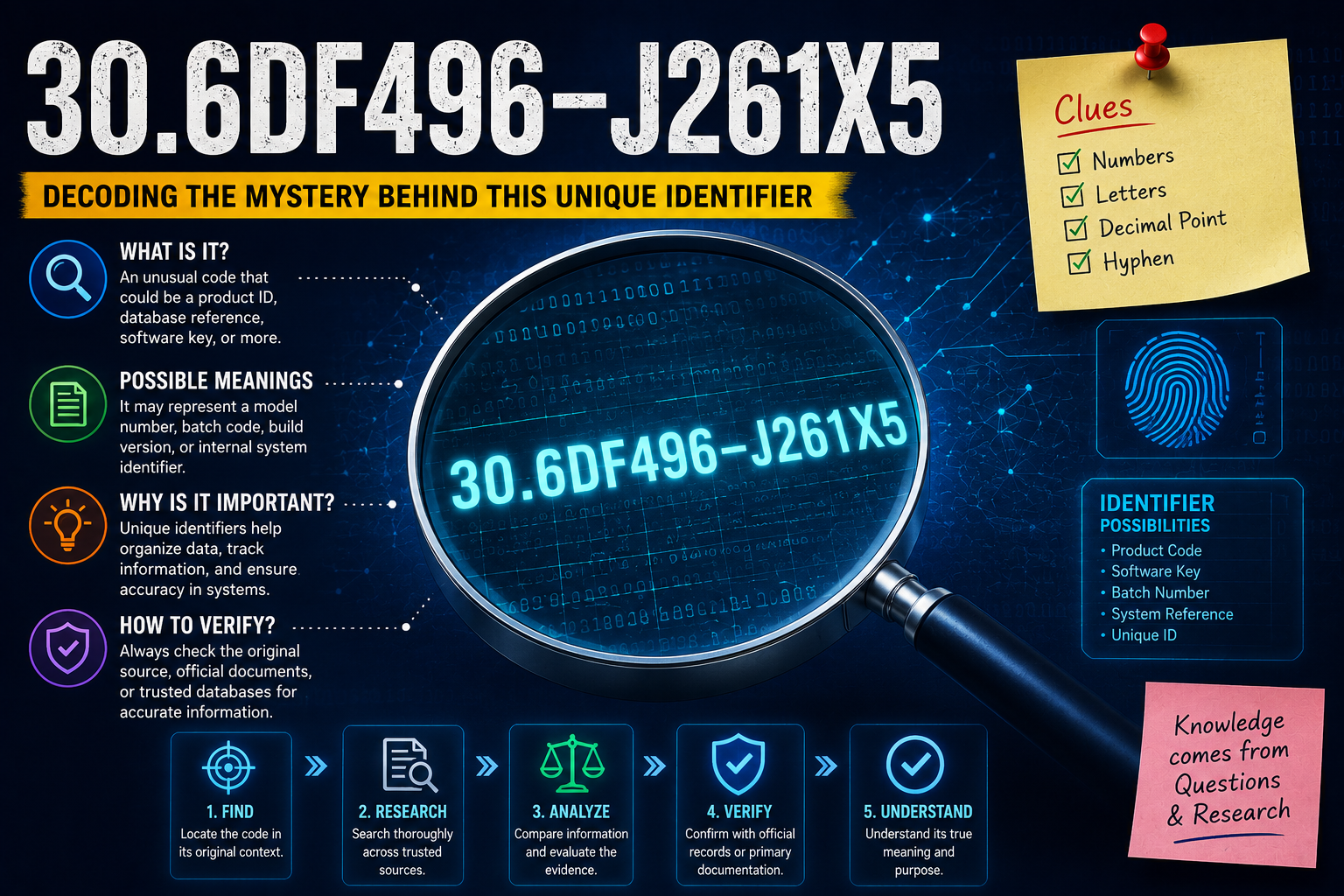
The term 30.6df496–j261x5 looks unusual at first glance. It combines numbers, letters, a decimal point, and a hyphen, creating the appearance of a technical code rather than a conventional word or product name. People who encounter 30.6df496–j261x5 may naturally wonder where it came from, what it represents, and why it appears in a particular document or online search.
The important point is that an unfamiliar identifier should be investigated through context rather than guesswork. A code can belong to a database, software system, technical record, product reference, sample, file, or another specialized system. This guide takes a fresh, practical approach to 30.6df496–j261x5 and explains how to examine such a term carefully.
Start With the Pattern
The structure of 30.6df496–j261x5 is the first clue, but it is not a complete explanation. Its mixed characters suggest that it may have been created for identification, tracking, or organization.
Many systems use combinations of letters and numbers because they make it possible to create large numbers of unique references. The resulting strings may look random to people even when they are perfectly meaningful inside the system that generated them.
When examining 30.6df496–j261x5, therefore, it is useful to ask what system could have produced it instead of assigning a meaning to each character.
Why the Format Matters
The decimal point and hyphen may be formatting elements rather than mathematical or scientific notation. Likewise, the letters may be abbreviations, randomly generated characters, or parts of an internal naming convention.
There is no universal rule that says every section of an identifier must have a fixed meaning. The original source is what gives the code its significance.
1. Think of It as a Reference First
A helpful starting point for 30.6df496–j261x5 is to treat it as a reference until evidence shows otherwise.
A reference can point to something without describing it. For example, a database can assign an ID to a record, while the record itself contains the actual description. A software application can use a generated string to identify a file or event. A manufacturer can assign a code to a component or batch.
This distinction prevents a common research error: assuming that an unusual sequence is automatically the name of the underlying item.
2. Find Where the Identifier Appeared
The source of 30.6df496–j261x5 may be more informative than the code itself.
If you found it on a website, examine the page title, headings, author information, and surrounding paragraphs. If it appeared in a document, check the table, section, caption, or footnote where it was used. If it came from software, note the application and the screen where the string appeared.
Context can quickly narrow down the possibilities.
Questions Worth Asking
- Was the identifier attached to a product?
- Did it appear beside a technical specification?
- Was it connected to a file or record?
- Was it shown in a laboratory or research context?
- Did a company or organization publish it?
These questions are useful because 30.6df496–j261x5 may have a meaning that is specific to one environment.
Read more: What Is 30.6df496–j261x5? 7 Key Insights About This Unusual Code
3. Avoid Decoding It Without Evidence
It can be tempting to break 30.6df496–j261x5 into pieces and assign a definition to each part. That approach can be misleading.
For instance, the number at the beginning may look like a measurement, while the letters may appear to form an abbreviation. But visual similarity is not evidence of a standardized meaning.
A reliable interpretation needs supporting information from the source that created the identifier.
This is particularly important when 30.6df496–j261x5 is discussed on websites that provide a very specific explanation without showing documentation. A confident tone does not make an unsupported interpretation accurate.
4. Consider the Digital Possibility
Modern software creates identifiers constantly. They can be used for sessions, records, files, requests, versions, objects, and other digital resources.
A generated identifier does not need to be memorable. Its main purpose may simply be to distinguish one item from another.
That possibility is relevant to 30.6df496–j261x5 because the term has a structure that could be compatible with machine-generated naming. However, this remains a possibility rather than a confirmed classification without information about its source.
Why Software Uses Complex Identifiers
Digital systems often need identifiers that are:
- Unique
- Easy for computers to process
- Consistent across records
- Unlikely to conflict with other references
- Suitable for automated workflows
A code that looks strange to a person can therefore be completely ordinary from a software perspective.
5. Could It Be a Product or Batch Reference?
Another possible context for 30.6df496–j261x5 is product tracking.
Businesses sometimes use internal codes for products, parts, batches, inventory records, shipments, or production stages. Such codes may appear on labels, invoices, databases, packaging, or internal documents.
However, the identifier alone cannot prove that it is a product code. You would need supporting information such as a manufacturer name, product description, catalog entry, barcode information, or official documentation.
If you encounter 30.6df496–j261x5 next to a product name, record both pieces of information before researching it further.
6. What If It Appears in a Research Document?
Research environments also rely heavily on reference systems.
A sample may receive a unique identifier so researchers can track it through testing and documentation. A project can contain multiple records, and each record may need a separate reference. A dataset can similarly use codes to distinguish entries.
In this setting, 30.6df496–j261x5 could be meaningful only within the relevant study, database, or organization.
That is why the surrounding text matters so much. Look for terms such as sample, record, experiment, dataset, reference, test, or specimen.
7. Use Exact-Match Searching
One of the easiest ways to investigate 30.6df496–j261x5 is to search the exact string.
Start with the identifier by itself. Then search it together with words from the original source. If necessary, try versions with slightly different punctuation to account for copying or formatting differences.
A Practical Search Sequence
Search one: the exact identifier.
Search two: the identifier plus the website or organization.
Search three: the identifier plus a nearby descriptive term.
Search four: the identifier without punctuation if the exact search produces nothing.
This method can help reveal whether the identifier appears consistently or whether different pages are using it in unrelated contexts.
8. Learn to Recognize Weak Evidence
When researching 30.6df496–j261x5, source quality matters.
Be cautious if an article:
- Gives a definite definition without naming its source
- Makes scientific claims without technical documentation
- Describes safety or health effects without evidence
- Says something is officially approved without identifying the authority
- Repeats unusual claims found on other low-quality pages
- Provides no date, author, organization, or supporting reference
These warning signs do not automatically make a page false, but they indicate that additional verification is needed.
Stronger Evidence
A stronger source may include an original technical document, official database entry, manufacturer specification, research publication, software documentation, or direct statement from the organization responsible for the identifier.
9. Separate Identification From Use
Knowing what 30.6df496–j261x5 refers to is different from knowing how something associated with it should be used.
This distinction is especially important if the identifier appears on a physical product or substance.
An identifier does not automatically tell you whether an item is safe, edible, medicinal, industrial, hazardous, or suitable for a particular application. Those questions require information about the actual item and its documented properties.
If a physical substance is involved, do not experiment with it based only on the code. Verify the identity and follow the appropriate official instructions first.
A Five-Step Verification Framework
If you need to investigate 30.6df496–j261x5 thoroughly, use this five-step framework.
Step 1: Capture
Save the original page, image, label, or document.
Step 2: Contextualize
Write down the words and information surrounding the identifier.
Step 3: Trace
Identify the organization, platform, database, or document associated with it.
Step 4: Compare
Look at multiple credible sources and determine whether their descriptions agree.
Step 5: Confirm
Prefer primary documentation before treating an interpretation as established.
This framework is useful because it turns an unfamiliar code into a structured research task.
Why Different Websites May Give Different Answers
Search results for 30.6df496–j261x5 may not always agree. This can happen when an identifier is copied incorrectly, interpreted without context, or repeated across websites without independent verification.
A page that appears first in search results is not automatically the most authoritative page.
Instead, compare the claims and ask where each source obtained its information. If several pages all trace back to one unsupported article, they should not be treated as independent confirmation.
What the Identifier Can and Cannot Tell You
By itself, 30.6df496–j261x5 can tell you that you have encountered a particular sequence of characters. It may also help you locate related records if the same identifier is indexed elsewhere.
What it cannot automatically tell you is the identity, safety, purpose, ownership, certification, or properties of whatever it references.
Those details must come from reliable supporting information.
This is an important principle for anyone dealing with technical codes: identification should come before interpretation, and interpretation should come before practical decisions.
Common Mistakes to Avoid
Mistake 1: Guessing From the Numbers
Numbers can look like measurements, dates, or specifications without actually being any of those things.
Mistake 2: Assuming Scientific Meaning
A technical-looking string is not necessarily a scientific formula or chemical identifier.
Mistake 3: Trusting Repetition
Repeated claims are not independent evidence when websites simply copy one another.
Mistake 4: Ignoring the Source
The page, document, organization, or system behind the code may contain the answer.
Mistake 5: Acting Before Verifying
If the identifier relates to a physical object or substance, practical use should wait until its identity and instructions are established.
A Reader-Friendly Way to Remember the Process
A simple formula can make the research process easier:
Code → Context → Source → Evidence → Conclusion
First, record the code. Second, understand where it appeared. Third, find the source behind it. Fourth, check the evidence. Finally, form a conclusion based on what can actually be supported.
This approach is useful not only for 30.6df496–j261x5 but also for unfamiliar product numbers, technical labels, database IDs, and software-generated references.
For readers researching 30.6df496–j261x5, this simple sequence can prevent premature conclusions and make the investigation more organized.
Read more: In an Apparent First, U.S. SEC Penalizes Crypto Hedge Fund
Frequently Asked Questions
What is 30.6df496–j261x5?
It is an unusual alphanumeric string that may function as an identifier or reference. Its exact meaning cannot be established from its appearance alone and depends on the source and context where it was created.
Is 30.6df496–j261x5 a standard technical term?
The identifier should not automatically be treated as a universal technical term. A specific system or organization may give it a specialized meaning.
Is it a chemical formula?
Its format alone does not establish that it is a chemical formula. Additional scientific documentation would be needed to make such a classification.
Could it be a software identifier?
That is one possible context because software frequently uses machine-readable identifiers. However, the source must be checked before confirming this interpretation.
Could it be a product code?
It could potentially be an internal product, batch, or inventory reference, but the identifier itself is not enough to confirm that.
How should I research 30.6df496–j261x5?
Start with the exact spelling, locate the original source, examine surrounding information, search the identifier, compare credible references, and look for primary documentation.
Is the identifier safe?
An identifier itself is neither safe nor unsafe. If it refers to a physical item, safety depends on the actual item and its verified properties and instructions.
Why is context important?
Context tells you what role the identifier plays. The same style of code can be used in very different systems, so the surrounding information is essential.
Final Thoughts
The most useful way to approach 30.6df496–j261x5 is as an identifier that needs context and verification.
Its unusual structure may suggest a technical, digital, product, research, or internal reference, but appearance alone cannot establish its exact purpose. The strongest answer comes from tracing the identifier back to its original source and checking the documentation connected with it.
If you encounter 30.6df496–j261x5 online, in software, on packaging, or inside a technical document, resist the urge to guess. Record the exact string, study its surroundings, identify the source, and compare reliable evidence.
For anyone searching 30.6df496–j261x5, the most reliable strategy is to build the explanation from documented information instead of assumptions.
That method produces a more accurate understanding and reduces the risk of repeating unsupported claims.
In the end, 30.6df496–j261x5 is best understood through evidence rather than speculation. Once the original context is identified, the code may become much easier to interpret, and the information surrounding it can provide the details needed for a confident conclusion.
