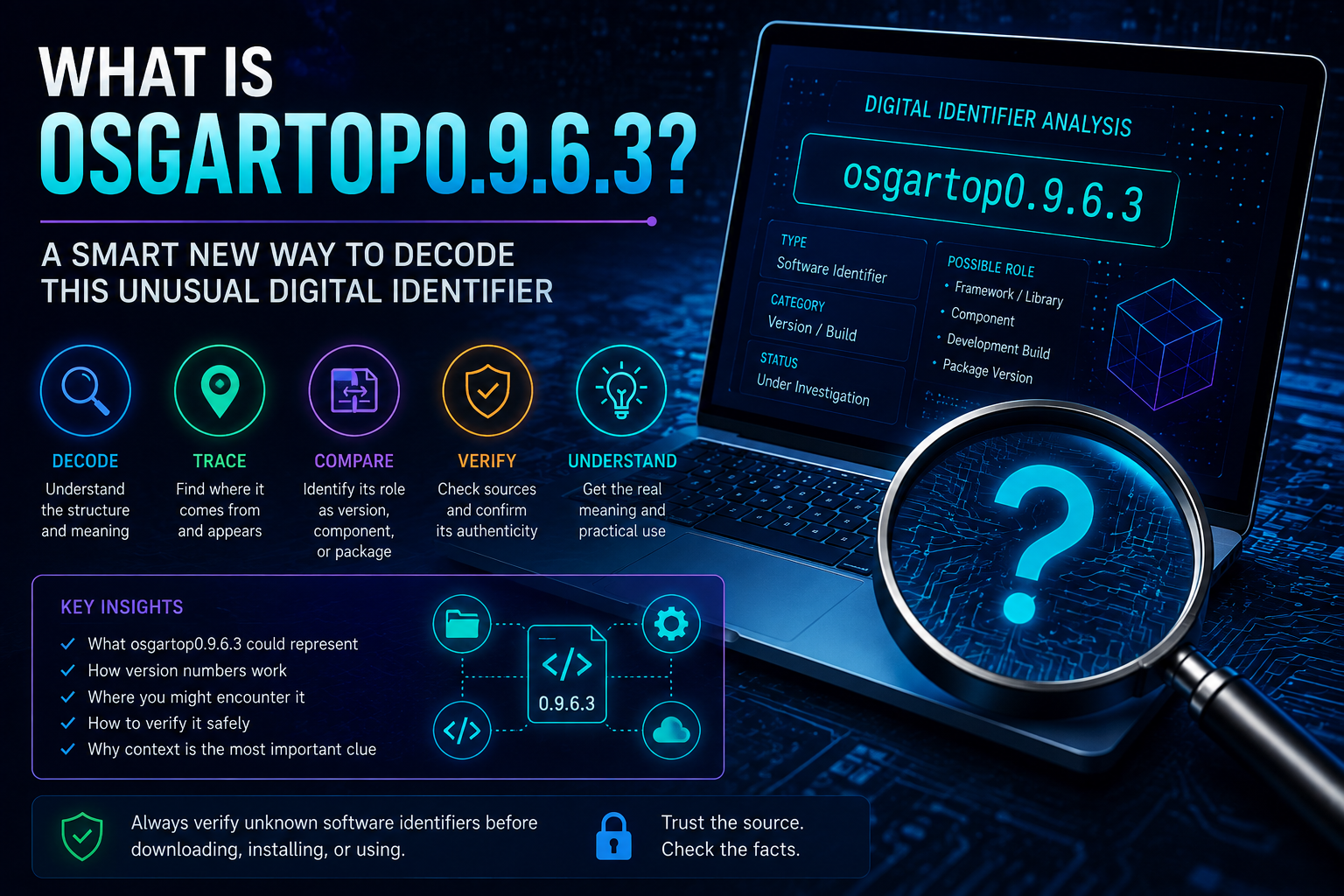
Introduction: A Code That Looks More Complicated Than It Is
Digital technology has introduced millions of names, identifiers, version numbers, package labels, and system references. Some are instantly recognizable, while others look like random combinations of letters and numbers. what is osgartop0.9.6.3 belongs to the second category.
At first sight, the identifier may appear confusing because it combines the word-like section “osgartop” with the numerical sequence “0.9.6.3.” This unusual structure naturally creates questions about its purpose, origin, software relationship, and technical importance.
Instead of assuming that every part has a fixed meaning, it is more useful to approach the identifier like a digital puzzle. Look at its structure, determine where it appears, investigate the surrounding information, and then compare the evidence with reliable technical sources.
This article uses a fresh method to explore what is osgartop0.9.6.3, focusing on how unusual identifiers can be interpreted, researched, verified, and understood in practical technology environments.
The First Clue: Its Unusual Structure
The most obvious clue in what is osgartop0.9.6.3 is the way the identifier is constructed.
It appears to contain:
osgartop + 0.9.6.3
This creates the impression of a project or component name followed by a version-style sequence.
In software development, this type of structure is common. Developers often attach numerical identifiers to projects so that different releases can be distinguished from one another.
However, structure alone does not provide a complete answer.
A four-part number could represent a release, revision, build, patch, testing stage, or an internal numbering system. Different projects use different conventions.
Therefore, what is osgartop0.9.6.3 should be investigated through evidence rather than interpreted solely from its appearance.
Decode: Understanding the Name Before the Technology
What Could “osgartop” Represent?
The “osgartop” portion of what is osgartop0.9.6.3 looks more like a technical name than a normal sentence or description.
Software projects frequently have names that are unfamiliar to the general public. These names may identify:
- applications;
- libraries;
- development components;
- frameworks;
- internal modules;
- testing projects;
- packages;
- repositories;
- system utilities.
The name itself does not tell us which category applies.
It is therefore useful to treat “osgartop” as the identity portion of the identifier until additional documentation provides a more specific explanation.
What Could “0.9.6.3” Represent?
The numerical part is equally interesting.
A sequence containing several periods is frequently associated with software versioning. A developer might use different numerical positions to represent major and minor releases, patches, builds, or revisions.
For example, a project could theoretically organize its versions as:
- Major release
- Feature release
- Patch
- Build
But that is only a general example.
There is no universal requirement that “0,” “9,” “6,” and “3” must have those exact meanings. The creator of the software determines the numbering system.
This is an important point when researching what is osgartop0.9.6.3, because guessing the meaning of each number can produce a misleading conclusion.
Trace: Where Could You Find the Identifier?
The location where an identifier appears can sometimes reveal more than the identifier itself.
If you are trying to understand what is osgartop0.9.6.3, start by asking where you encountered it.
1. Inside a Software Folder
If the identifier appears in an installation directory, it could potentially be associated with a program, module, dependency, or specific software build.
2. Inside a Log File
Technical logs commonly record version numbers and component names. In this environment, the identifier could be used to identify the exact software state involved in an event.
3. Inside a Configuration File
Configuration files can contain references to dependencies, modules, versions, and system components.
4. In a Download Filename
A downloadable package may include its version number directly in the filename. The download page and publisher would then become important evidence.
5. In a Developer Environment
Developers often encounter technical identifiers while working with repositories, packages, testing environments, deployment systems, and dependency managers.
The same identifier can therefore have different implications depending on its location.
Read more: 30.6df496–j261x5: 9 Powerful Insights to Understand This Unusual Identifier
Compare: Identifier, Version, or Product?
One of the biggest challenges surrounding what is osgartop0.9.6.3 is determining exactly what type of thing it represents.
A technical-looking name does not automatically mean it is a complete application.
It Could Be a Version
The simplest possibility is that the identifier represents a particular release of a software project.
It Could Be a Component
Large software systems are often divided into smaller components. Each component can have its own identifier and version.
It Could Be a Package
Software package systems commonly use names and version numbers to identify installable components.
It Could Be an Internal Reference
Companies and development teams sometimes use internal labels that never become recognizable public product names.
It Could Be a Build Identifier
A development team may create several builds while testing software. Each build can receive a unique reference.
This range of possibilities is why what is osgartop0.9.6.3 should not be assigned one definitive identity without supporting evidence.
The Versioning Mystery
Why Does the Number Begin With Zero?
The “0” in what is osgartop0.9.6.3 may attract particular attention.
In some software projects, versions beginning with zero are associated with development, experimentation, or pre-release stages. A project may later move toward a 1.0 release when developers consider it mature enough for wider use.
But this is not a universal rule.
Some projects simply choose a numbering convention that begins with zero. Others may use the first number for an entirely different internal purpose.
Therefore, the opening zero can be considered a clue, but not proof of a particular development stage.
Why Are There Four Numbers?
Four-part versions can provide additional precision.
A developer may want to distinguish between two builds that share the same major and minor version. Adding another number allows a team to track smaller changes.
For example:
0.9.6.1
0.9.6.2
0.9.6.3
could theoretically represent three different revisions.
This is only an illustrative example, but it shows why a multi-part identifier can be useful.
Investigate: What Information Should You Collect?
If you have personally encountered what is osgartop0.9.6.3, do not research only the name. Collect the surrounding evidence.
Write down:
- where the identifier appeared;
- the file or application name;
- the file extension;
- the publisher;
- the operating system;
- nearby text;
- related version information;
- the date you discovered it;
- the website or source where it appeared.
These details can dramatically improve the accuracy of your investigation.
For example, searching only the identifier may produce broad results. Searching the identifier together with a filename, publisher, or software name can narrow the results considerably.
Verify: Separating Facts From Assumptions
A major part of understanding what is osgartop0.9.6.3 is learning how to separate verified information from speculation.
Online articles sometimes describe unusual identifiers with great confidence. However, a confident statement is not automatically a verified statement.
A strong verification process should prioritize:
Official Documentation
Look for documentation created by the software developer or project owner.
Source Repositories
Public repositories can reveal project names, releases, version history, dependencies, and development activity.
Package Registries
If the identifier represents a package, an established package registry may provide useful version information.
Release Notes
Release notes can explain what changed between different versions.
Security Information
If the identifier is associated with an executable file, investigate its publisher and security reputation before running it.
These sources are generally more useful than an article that simply repeats the same unexplained code.
Practical Test: Five Questions to Ask
Anyone researching what is osgartop0.9.6.3 can use five simple questions.
Question 1: Where Did It Come From?
The original source is often the most valuable clue.
Question 2: What Is Around It?
Look at the text, filenames, folders, or documentation surrounding the identifier.
Question 3: Who Created It?
A developer, organization, or project owner may be identifiable through the original source.
Question 4: Does the Version Exist Elsewhere?
Look for matching references in documentation, release records, or repositories.
Question 5: Is the Source Trustworthy?
An official technical source is usually more reliable than an anonymous page making unsupported claims.
This five-question method makes researching what is osgartop0.9.6.3 more systematic.
Why Technical Identifiers Matter
It may seem strange that developers need complicated names such as what is osgartop0.9.6.3, but identifiers serve important purposes.
Better Troubleshooting
When a problem occurs, technicians need to know exactly which component or release was involved.
Easier Maintenance
Version information helps teams determine which software requires an update.
Better Compatibility
Different versions can work differently with operating systems, libraries, databases, and other dependencies.
Accurate Documentation
Technical teams can record the exact versions used in a project.
Reproducible Environments
Developers can recreate an environment more accurately when component versions are known.
Thus, a strange-looking identifier can have significant practical value even if it does not look meaningful to an ordinary user.
Read more: Unconfirmed: UAE Preparing to Adopt Formal ICO, Fintech Regulations
What This Identifier Does Not Prove
Another important part of understanding what is osgartop0.9.6.3 is recognizing what cannot be concluded from the name alone.
The identifier does not automatically prove that it is:
- malware;
- a cryptocurrency platform;
- a consumer application;
- a security threat;
- a database;
- a specific programming framework;
- a standardized technology;
- or a popular commercial product.
These conclusions require independent evidence.
A technical-looking string can belong to a completely legitimate internal component.
Likewise, a familiar-looking software name can potentially be used by an untrusted source.
The correct approach is therefore evidence first, conclusion second.
A Better SEO-Friendly Way to Understand the Topic
For readers searching what is osgartop0.9.6.3, the most useful information is not simply a one-line definition.
People usually want to know several things:
- What does the identifier mean?
- Why does it contain numbers?
- Is it related to software?
- Where might it appear?
- Is it a version number?
- How can it be verified?
- Is it safe?
- Why is it important?
Answering these questions creates a much more useful resource than repeating a short definition.
It also demonstrates why context is essential when dealing with unusual digital terminology.
Common Research Mistakes
Searching Only One Website
One page can contain an incomplete or inaccurate explanation. Compare multiple reliable sources.
Changing the Spelling
Technical identifiers can be sensitive to punctuation, capitalization, and numbers. Copy the identifier exactly.
Assuming Every Number Means the Same Thing
Different projects use different numbering systems.
Downloading Unknown Files
If your research leads to an unfamiliar executable, do not run it simply because its filename contains the identifier.
Ignoring the Original Context
The location where you discovered the identifier can be one of the strongest clues.
Avoiding these mistakes makes investigating what is osgartop0.9.6.3 considerably more reliable.
A Simple Research Workflow
You can turn the investigation into a repeatable workflow.
Discover
Find the original place where the identifier appeared.
Record
Copy the exact spelling and collect surrounding information.
Search
Use exact-match searches to locate references to the same identifier.
Compare
Evaluate multiple sources rather than relying on one result.
Verify
Prioritize official documentation and technical evidence.
Understand
Only after verification should you decide what the identifier represents.
This workflow can be useful for many unfamiliar technical names, not just what is osgartop0.9.6.3.
Frequently Asked Questions
What is osgartop0.9.6.3 in simple terms?
It appears to be a technical identifier combining a name-like term with a multi-part numerical sequence that resembles software versioning. Its exact purpose requires confirmation from its original source.
Is osgartop0.9.6.3 definitely a software framework?
It may be associated with software technology according to some online descriptions, but a specific classification should be verified through authoritative documentation.
What does 0.9.6.3 mean?
It may represent a release, revision, patch, build, or another numbering scheme. There is no universal rule assigning one meaning to each number.
Is osgartop0.9.6.3 dangerous?
The name alone cannot determine whether something is safe or dangerous. The associated file, publisher, source, and behavior must be evaluated.
Can it be an internal software component?
Yes. Internal components, dependencies, builds, and modules often have technical names that are unfamiliar to general users.
How can I identify it more accurately?
Start with the location where you found it, record the surrounding information, search the exact identifier, and verify the results using original documentation or trustworthy technical sources.
Final Takeaway
The most useful way to approach what is osgartop0.9.6.3 is to think of it as a digital identification puzzle rather than a term that can be decoded instantly.
Its structure suggests a name-like component followed by a multi-part numerical identifier. That format is compatible with several software-related possibilities, including a version, build, package, component, or internal reference.
However, structure alone is not enough to establish its exact identity.
If you encounter what is osgartop0.9.6.3 in a software environment, the strongest clues will usually come from its location, surrounding files, publisher, documentation, and related technical records.
The safest and most accurate approach is to decode the structure, trace the source, compare the evidence, verify the information, and only then reach a conclusion.
Ultimately, what is osgartop0.9.6.3 is best understood through context rather than guesswork. Its unusual appearance may make it seem mysterious, but careful investigation can turn an unfamiliar digital identifier into a much clearer technical reference.
