ChatGPT said:
Understanding Rigging in 3D
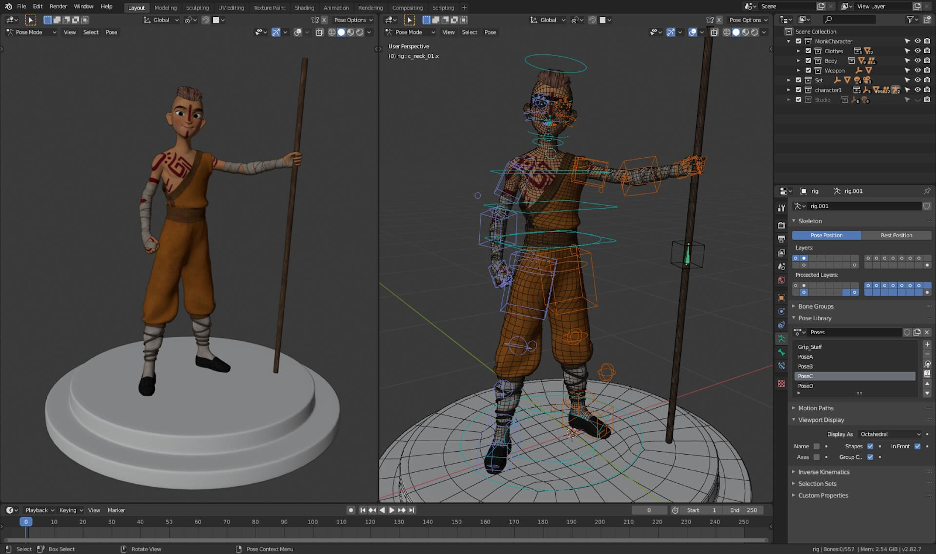
Rigging is a fundamental step in 3D animation that enables models to move and perform actions realistically. While modeling defines a character’s shape, and texturing adds surface detail, rigging provides the skeleton, controls, and deformation systems that allow a character to animate. Without rigging, characters would remain static, incapable of expressing emotion, performing actions, or interacting with the environment. Rigging bridges the gap between static 3D models and dynamic animated performances, making it an essential skill in film, games, and interactive media.
The Role of a Rigger
A rigger is responsible for creating the internal skeletal structure and control systems for a 3D character. Their work ensures that characters can move naturally and respond appropriately to forces in the scene. Rigging involves more than just bones—it includes inverse kinematics (IK), forward kinematics (FK), constraints, skinning, and control interfaces for animators. A skilled rigger anticipates the animator’s needs, creating intuitive rigs that balance complexity, flexibility, and performance. Proper rigging is crucial for maintaining the integrity of a model during motion and ensuring smooth animation workflows.
Skeletons and Joint Placement
The first step in rigging is constructing the skeletal framework, or joint hierarchy, of a character. Joints define pivot points for movement, such as shoulders, elbows, knees, and fingers. Accurate placement is vital for realistic deformation—misaligned joints can cause unnatural bending or stretching. Riggers often use reference from human or animal anatomy to determine proper joint locations. The hierarchy must be carefully structured, ensuring parent-child relationships that allow predictable motion throughout the rig.
Forward Kinematics (FK) vs. Inverse Kinematics (IK)
Forward kinematics and inverse kinematics are two essential methods for controlling joint movement:
-
Forward Kinematics (FK): The animator rotates each joint individually, moving the limbs sequentially. FK provides precise control over rotational motion and is ideal for arcs and flowing movements.
-
Inverse Kinematics (IK): The animator manipulates the end of a chain, such as a hand or foot, and the system automatically calculates joint rotations to achieve the target position. IK simplifies tasks like walking or placing a hand on a surface.
Many rigs combine FK and IK, allowing animators to switch between methods depending on the type of motion required.
Control Curves and Interfaces
To make rigs user-friendly, riggers create control curves or controllers. These visual elements allow animators to manipulate the rig without directly adjusting joints, reducing the risk of errors. Controllers can manage complex systems like facial expressions, finger curls, or muscle deformations. Good control design prioritizes clarity, ease of selection, and logical naming conventions, enabling animators to work efficiently and intuitively.
Skinning and Weight Painting
Skinning is the process of binding the 3D mesh to the underlying skeleton so that it deforms properly during animation. Weight painting assigns influence values to joints, determining how much each vertex moves when a joint rotates. Proper skinning ensures smooth deformation, avoiding unnatural pinching or collapsing of geometry. Advanced techniques like dual quaternion skinning help preserve volume in twisting limbs, contributing to realistic character motion.
Facial Rigging and Expressions
Facial rigging allows characters to express emotion through movement of eyes, eyebrows, lips, and other facial features. Techniques include blend shapes (morph targets), bone-based rigs, or a combination of both. Blend shapes interpolate between pre-defined facial expressions, while bone rigs provide dynamic control over structure. Facial rigs often include controllers for subtle movements such as squints, blinks, and jaw shifts, enabling animators to convey nuanced emotions and dialogue convincingly.
Deformers and Advanced Rigging Techniques
Deformers are tools that modify geometry without altering the skeleton directly. Common deformers include lattices, clusters, and skin wrap systems, which help correct problematic areas or create stylized effects. Advanced rigs may incorporate muscle systems, dynamic joints, or secondary motion setups to simulate realistic muscle bulges, skin sliding, or cloth movement. These techniques enhance realism and provide animators with flexible, responsive characters.
Rigging for Different Types of Characters
Rigging techniques vary depending on the type of character:
-
Humanoid Characters: Require detailed joint hierarchies, facial rigs, and IK/FK systems for limbs.
-
Creatures and Animals: Often include unique limb structures, tail rigs, and special IK systems for quadrupedal movement.
-
Mechanical Objects and Vehicles: May rely on hierarchical rigging, constraints, and articulation systems rather than organic deformation.
Understanding the specific needs of each character type ensures functional, expressive rigs suitable for the intended animation style.
Rigging for Games vs. Film
Rigging for games differs from film in several ways. Game rigs must perform in real-time, so efficiency and optimization are crucial. Low-poly meshes, simplified deformation, and limited controllers are common. In contrast, film rigs can afford higher complexity and detail since frames are pre-rendered. Film rigs often include corrective blend shapes and additional layers of control to achieve cinematic quality. Riggers must adapt their workflows to meet the technical and artistic demands of the medium.
Constraints and Automation in Rigging
Constraints are tools that automate relationships between objects in a rig. Examples include parent constraints, aim constraints, and point constraints. They simplify repetitive tasks, maintain consistency, and allow secondary motion to behave naturally. Automation scripts and rigging tools further enhance efficiency, enabling riggers to generate complex systems quickly and reliably. These tools reduce errors and provide animators with predictable, easy-to-use rigs.
Testing and Iteration in Rigging
Testing is a critical step in rig development. Riggers must evaluate joint deformation, controller behavior, and compatibility with animation workflows. Animators often provide feedback on usability and flexibility. Iteration ensures that rigs perform as intended under a variety of motions and scenarios. Continuous testing prevents costly adjustments later in production and guarantees that characters maintain quality throughout animation sequences.
Rigging for Dynamic Simulation
Some rigs incorporate dynamic simulations for secondary motion, such as hair, cloth, tails, or flexible armor. These systems automatically respond to movement, adding realism and weight. Techniques include soft-body dynamics, spline IK, and physics-driven controllers. Integrating simulation into rigs reduces manual animation work and enhances believability, but requires careful tuning to avoid instability or unnatural behavior.
The Importance of Naming and Organization
A well-organized rig is essential for both efficiency and collaboration. Clear naming conventions, layer management, and grouped controllers prevent confusion and errors. Rigging pipelines often follow studio standards to ensure consistency across assets. Proper organization is especially important in large productions where multiple animators interact with the same rigs. Clean, logical structure improves workflow and reduces the potential for mistakes during animation.
Rigging for Motion Capture Integration
Motion capture data requires specialized rig setups. Retargeting involves mapping captured motion onto the 3D character rig. The rig must match the skeletal structure of the mocap system, allowing natural transfer of movement. Additional controllers often handle offsets, scaling, and secondary motion to preserve realism. Efficient mocap rigs streamline the process of producing high-quality animation while maintaining character integrity.
Common Rigging Challenges
Rigging presents numerous challenges, including joint placement errors, skinning artifacts, and controller complexity. Maintaining volume during twisting or bending, ensuring smooth transitions between IK and FK, and managing facial deformations are common issues. Riggers must troubleshoot problems creatively, using corrective blend shapes, additional joints, or deformers. Experience and iterative refinement are key to overcoming these challenges effectively.
Collaboration Between Riggers and Animators
Successful rigging requires close collaboration with animators. Riggers must anticipate animation needs, while animators provide feedback on rig usability and flexibility. This partnership ensures that rigs support expressive motion, storytelling, and technical requirements. Open communication and iterative testing strengthen pipelines and result in higher-quality animation.
Future Trends in Rigging
The future of rigging is being shaped by automation, AI, and procedural systems. AI-assisted rigging can generate joints, controllers, and skin weights automatically, reducing setup time. Procedural rigs allow for adaptable, modular setups that can be reused across characters. Real-time engines increasingly incorporate advanced rigging features, enabling live previews and interactive adjustments. As technology evolves, rigging will become faster, more intuitive, and more powerful, allowing artists to focus on creativity and expression.
Conclusion
Rigging is the backbone of 3D animation, transforming static models into expressive, dynamic characters. It requires a blend of technical expertise, artistic insight, and problem-solving skills. From skeleton creation and skinning to facial rigs and dynamic simulation, rigging enables characters to move convincingly and tell stories effectively. Mastery of rigging empowers animators and production teams to bring characters to life, creating immersive and emotionally engaging experiences across film, games, and interactive media.
This article provides a comprehensive overview of 3D rigging, offering guidance for both aspiring and experienced artists to create functional, expressive, and efficient character rigs.
