Introduction
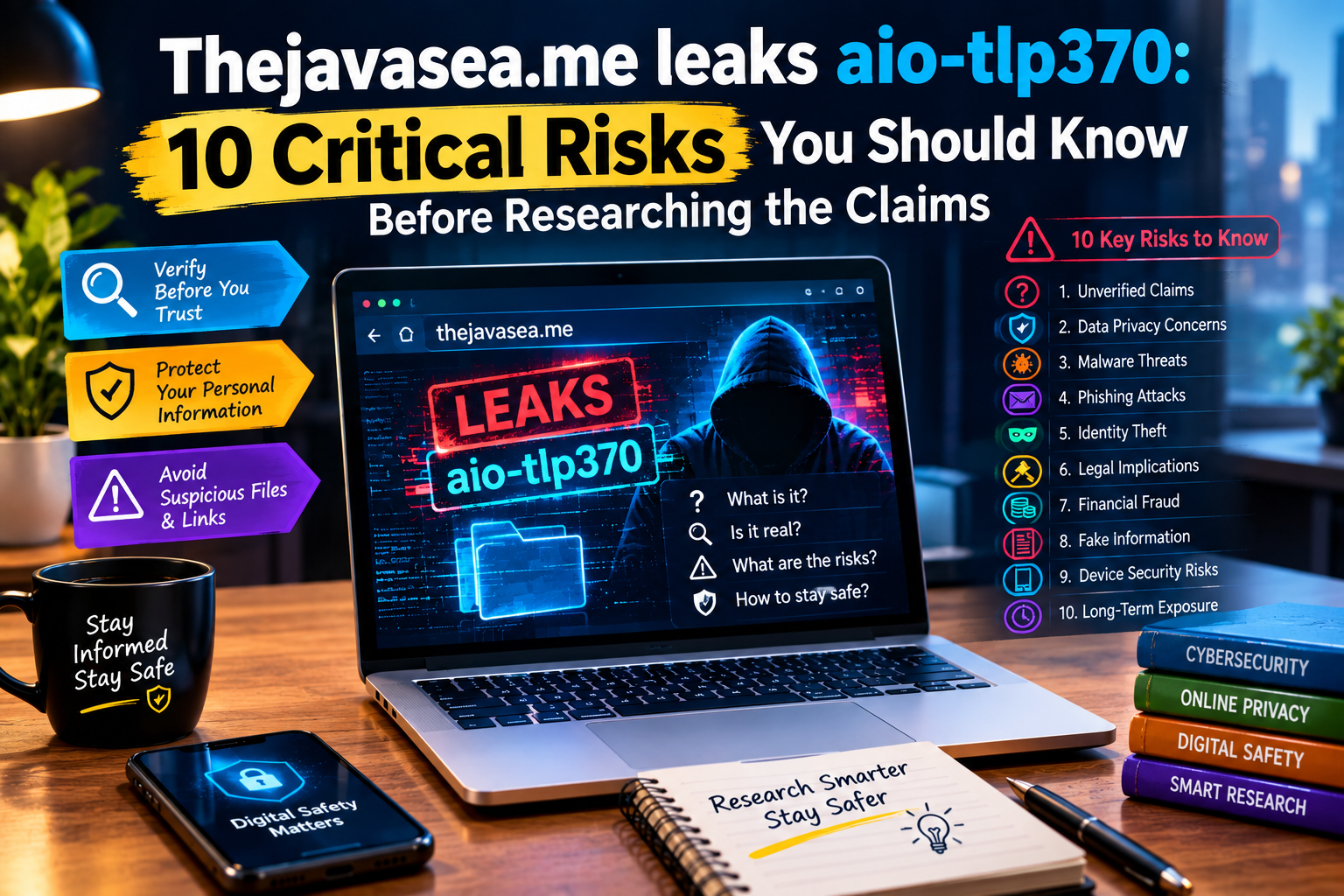
The phrase thejavasea.me leaks aio-tlp370 has attracted attention because it looks like a specific technical identifier connected to leaked or redistributed digital material. However, the public information currently available does not establish one definitive explanation of the label, its exact contents, origin, size, or whether it represents a newly confirmed data breach. Recent articles repeatedly describe it as an unverified leak-related package or archive, while some make more specific claims without authoritative confirmation.
That uncertainty is important. A technical-looking name can make an online claim appear more official than it really is. In the case of thejavasea.me leaks aio-tlp370, the safest approach is to separate what is observable from what is merely repeated online.
This guide explains the terminology, the verification problem, security concerns, and practical steps readers can take without accessing or distributing questionable material. The goal is to understand the search term while keeping privacy and digital safety at the center.
1. The First Question: What Does the Phrase Point To?
At a basic level, thejavasea.me leaks aio-tlp370 appears to combine a website or domain reference with the word “leaks” and an identifier called “AIO-TLP370.” Search results describe the phrase as being associated with an alleged archive, bundle, post, or collection of digital material.
The key word is “alleged.” There is not enough authoritative public evidence to confirm that the label represents a standalone breach with a verified victim, authenticated dataset, or independently established record count. Several recent pages explicitly warn that claims about the package remain difficult to verify.
For readers searching thejavasea.me leaks aio-tlp370, this distinction matters because a search result is not automatically evidence. A page can repeat information from another page without independently checking the original claim.
2. Breaking the Identifier Into Parts
The wording becomes easier to understand when separated into components.
“thejavasea.me” is the domain portion of the phrase.
“leaks” signals that the discussion concerns material alleged to have been distributed without authorization.
“AIO” commonly means “All-In-One” in technology terminology, but that expansion has not been officially confirmed for this particular identifier.
“TLP370” looks like a package, thread, release, or internal reference number. It should not automatically be interpreted as an official cybersecurity classification.
Therefore, thejavasea.me leaks aio-tlp370 should be treated as a descriptive search phrase rather than proof that every claim attached to it is authentic.
This is especially important when an unfamiliar identifier contains technical-looking abbreviations. Familiar terminology can create an impression of authority even when the label itself has no recognized technical standard behind it.
3. Why TLP370 Can Be Misleading
One of the biggest sources of confusion is the letters “TLP.” Traffic Light Protocol is a legitimate information-sharing framework used in cybersecurity. FIRST’s current standard recognizes four core labels: TLP:RED, TLP:AMBER, TLP:GREEN, and TLP:CLEAR.
“TLP370” is not one of those official classifications. The presence of “TLP” in AIO-TLP370 therefore does not prove that a package has been reviewed, classified, or endorsed by a cybersecurity authority.
This distinction is particularly important when researching thejavasea.me leaks aio-tlp370. A label can borrow familiar technical language without having an official relationship to the system that language normally describes.
The real Traffic Light Protocol is designed to communicate information-sharing boundaries, not to identify leak packages or assign numbers to alleged archives. FIRST explains that only the labels listed in its standard are valid TLP labels.
4. Is It a Confirmed Data Breach?
The available public material does not provide sufficient authoritative evidence to call thejavasea.me leaks aio-tlp370 a confirmed standalone data breach.
A verified breach normally has stronger evidence, such as an identified affected organization, a credible incident disclosure, technical investigation, authenticated samples, or another reliable source establishing what happened.
Some websites publish precise claims about contents, file sizes, dates, victims, or exposed information. Those claims should not automatically be treated as established facts merely because several websites repeat similar wording. Recent coverage itself notes that descriptions of AIO-TLP370 vary and that authoritative confirmation is limited.
For that reason, thejavasea.me leaks aio-tlp370 is better described as an unverified leak-related identifier unless stronger evidence becomes publicly available.
Read more: CruzDid Com: 7 Powerful Tips for Digital Content, Online Safety & Smart Browsing
5. Why Unverified Leak Claims Spread Quickly
Leak-related keywords often spread faster than reliable verification. A short identifier is easy to copy into headlines, social posts, forum discussions, and search pages.
As a result, thejavasea.me leaks aio-tlp370 can become increasingly visible even when the underlying evidence remains limited.
Search popularity itself is not evidence that a breach is genuine, large, recent, or dangerous. It simply indicates that people are searching for or discussing the phrase.
Another problem is terminology. Words such as “database,” “dump,” “archive,” and “breach” may be used interchangeably online even though they can describe very different situations.
A bundle might contain old material, duplicates, fabricated files, unrelated data, or material from several sources. Without independent verification, it is not responsible to present every description as fact.
6. The Security Risk Is Real Even When the Claim Is Unverified
Uncertainty about a leak does not mean that interacting with unknown files is safe.
For someone researching thejavasea.me leaks aio-tlp370, the safest approach is to avoid downloading an alleged archive simply to see what it contains. Unknown files and suspicious websites can expose users to phishing, malicious software, deceptive redirects, credential theft, or other security problems.
This creates an important distinction:
The authenticity of a specific leak claim and the general security risk of interacting with unknown leak sources are two separate questions.
Even if the underlying claim eventually turns out to be inaccurate, downloading unknown files can still create unnecessary security exposure.
7. A Safer Way to Check Your Own Exposure
If you are searching thejavasea.me leaks aio-tlp370 because you are worried that your information may have appeared in a breach, use established account-security methods instead of attempting to obtain leaked material.
Start by checking security notifications provided by your email provider, password manager, or relevant online service. If a service has officially announced an incident, follow its recommended response.
You can also use a reputable breach-notification service that allows you to check whether an email address has appeared in known incidents without downloading questionable datasets.
If a password may have been exposed, change it on the affected service and anywhere else you reused it. Use unique passwords, enable multi-factor authentication where available, and review recent login activity.
These actions are more useful than searching for copies of thejavasea.me leaks aio-tlp370.
8. What If You Already Downloaded Something Suspicious?
If you have already downloaded a file associated with thejavasea.me leaks aio-tlp370, do not open or execute it simply to inspect its contents.
A sensible first step is to avoid entering additional credentials into suspicious websites and, where appropriate, disconnect a potentially compromised device from sensitive accounts while it is being checked.
Run a reputable security scan, update your operating system and security software, and review account activity from a separate trusted device when possible.
If credentials were entered into a suspicious page, change those credentials from a trusted device and enable multi-factor authentication. If financial or identity information may have been exposed, contact the relevant provider or institution through an official channel.
Do not upload suspicious files to random analysis websites if those files may contain private or sensitive information.
9. Privacy and Legal Considerations
Leak-related material can involve personal data, copyrighted material, private communications, credentials, or other information that was never intended for public distribution.
For readers researching thejavasea.me leaks aio-tlp370, this means there are more considerations than simply asking whether a file exists.
Downloading, storing, sharing, or redistributing unauthorized material can create privacy, ethical, or legal problems depending on the jurisdiction and circumstances.
A safer research strategy is to focus on public reporting and defensive cybersecurity information rather than attempting to obtain the alleged material.
If your concern is about your own data, there is no need to access another person’s private information to protect yourself.
10. A Five-Point Verification Framework
When you encounter a claim about thejavasea.me leaks aio-tlp370, use five basic questions.
Question 1: Who Originally Made the Claim?
Find out whether the information came from an identifiable organization, researcher, journalist, or anonymous account.
Question 2: Is There an Identifiable Affected Organization?
A genuine breach report normally identifies who was affected or provides another credible explanation of the incident.
Question 3: Is There Primary Evidence?
Look for an official incident statement, technical report, or credible independent investigation.
Question 4: Are Specific Claims Supported?
Be cautious with exact record counts, file sizes, dates, victim lists, and technical descriptions when no evidence is provided.
Question 5: Can the Claim Be Independently Verified?
If multiple websites are simply repeating the same statement, they may not represent independent confirmation.
This framework is useful because it prevents thejavasea.me leaks aio-tlp370 from being treated as automatically genuine simply because it appears in many search results.
What Reliable Evidence Would Look Like
A strong verification trail for a major incident would normally contain multiple independent elements.
These might include a statement from an affected organization, a reputable cybersecurity investigation, technical indicators that can be independently examined, or credible evidence showing when and how an exposure occurred.
By contrast, an anonymous post, unexplained filename, screenshot, or collection of articles repeating one another does not by itself establish authenticity.
This standard matters because descriptions of thejavasea.me leaks aio-tlp370 currently vary across online sources. Some pages describe it as a bundle or archive, while others make stronger claims about its contents. That difference is a reason to maintain caution rather than choose the most dramatic explanation.
Read more: Government Expert: Russia Not Ready for Issuance and Circulation of Cryptocurrencies
How to Write About the Topic Responsibly
For publishers and SEO writers, thejavasea.me leaks aio-tlp370 creates an additional challenge.
Search demand can encourage exaggerated headlines, but accurate content should distinguish confirmed information, reasonable interpretation, and online allegations.
An article should not invent a victim organization, record count, file size, breach date, or technical classification. It should also avoid linking readers to alleged stolen material.
A useful article can explain the search term, discuss cybersecurity risks, and provide defensive guidance without helping people locate or redistribute private data.
Why Verification Matters for SEO Readers
Search engines can surface many pages about the same unusual keyword. That does not mean all of those pages represent independent reporting.
Readers searching thejavasea.me leaks aio-tlp370 should compare sources rather than counting how many articles repeat the same sentence.
Ten copied pages do not provide ten independent confirmations.
For content creators, this is also a useful SEO lesson: a page can target a high-interest keyword while still using cautious language, transparent sourcing, and a clear distinction between evidence and speculation.
Common Misunderstandings
AIO Automatically Means a Complete Data Collection
Not necessarily. “AIO” commonly means “All-In-One,” but the exact meaning of the label in this specific context has not been authoritatively established.
TLP370 Is an Official Security Classification
It is not. FIRST’s official TLP standard recognizes TLP:RED, TLP:AMBER, TLP:GREEN, and TLP:CLEAR.
Search Popularity Proves Authenticity
It does not. A heavily searched phrase can represent curiosity, speculation, copied content, or genuine reporting.
Downloading a Leak Is the Best Way to Check Your Data
It is not. If you are concerned about personal exposure, legitimate breach-notification tools and official security notices are safer options.
Every Article Is Independent Reporting
Not necessarily. Online content can be copied, rewritten, summarized, or generated from the same original rumor.
A Better Research Workflow
A safer workflow for thejavasea.me leaks aio-tlp370 can be summarized in six stages:
Search → Compare → Verify → Protect → Monitor → Update
First, search broadly enough to understand how the phrase is being described.
Second, compare multiple sources and look for differences.
Third, verify important claims against authoritative evidence.
Fourth, protect your accounts using strong unique passwords and multi-factor authentication.
Fifth, monitor relevant account activity for unusual behavior.
Finally, update your understanding if a reliable organization later confirms or disproves specific claims.
This workflow keeps research focused on evidence instead of curiosity-driven access to questionable material.
Final Takeaway
The phrase thejavasea.me leaks aio-tlp370 should currently be approached as an unverified leak-related identifier rather than a confirmed description of a specific, independently authenticated breach.
Public pages discuss the phrase in different ways, and the available evidence does not establish a definitive origin, contents, affected organization, or record count.
The most useful response is therefore practical rather than sensational. Do not download or redistribute alleged leaked material. Verify important claims through reliable sources. If you are worried about your own information, use legitimate breach-notification and account-security tools, change reused passwords, enable multi-factor authentication, and monitor important accounts.
For anyone researching thejavasea.me leaks aio-tlp370, the central lesson is simple: a technical-looking label is not the same thing as verified evidence.
Careful source checking and defensive security habits provide a safer path than curiosity-driven access to questionable files.
Frequently Asked Questions
What is thejavasea.me leaks aio-tlp370?
It is an online phrase associated with an alleged leak-related archive, package, post, or collection. The exact contents and origin are not established by authoritative public evidence.
Is AIO-TLP370 an official cybersecurity classification?
No. TLP370 is not one of the official Traffic Light Protocol labels recognized by FIRST.
Is the alleged leak confirmed?
The public evidence reviewed for this article does not establish it as a confirmed standalone breach with a verified victim organization, authenticated contents, or confirmed record count.
Should I download the alleged files?
No. Downloading unknown leak files can create security, privacy, ethical, and legal risks.
What should I do if I am worried about my information?
Check official security notifications, use a reputable breach-notification service, change exposed or reused passwords, enable multi-factor authentication, and monitor account activity.
Why are there different explanations online?
Descriptions can differ because leak-related pages may repeat unverified claims, use different terminology, or interpret an internal identifier differently. Conflicting descriptions are a reason to verify rather than assume.
