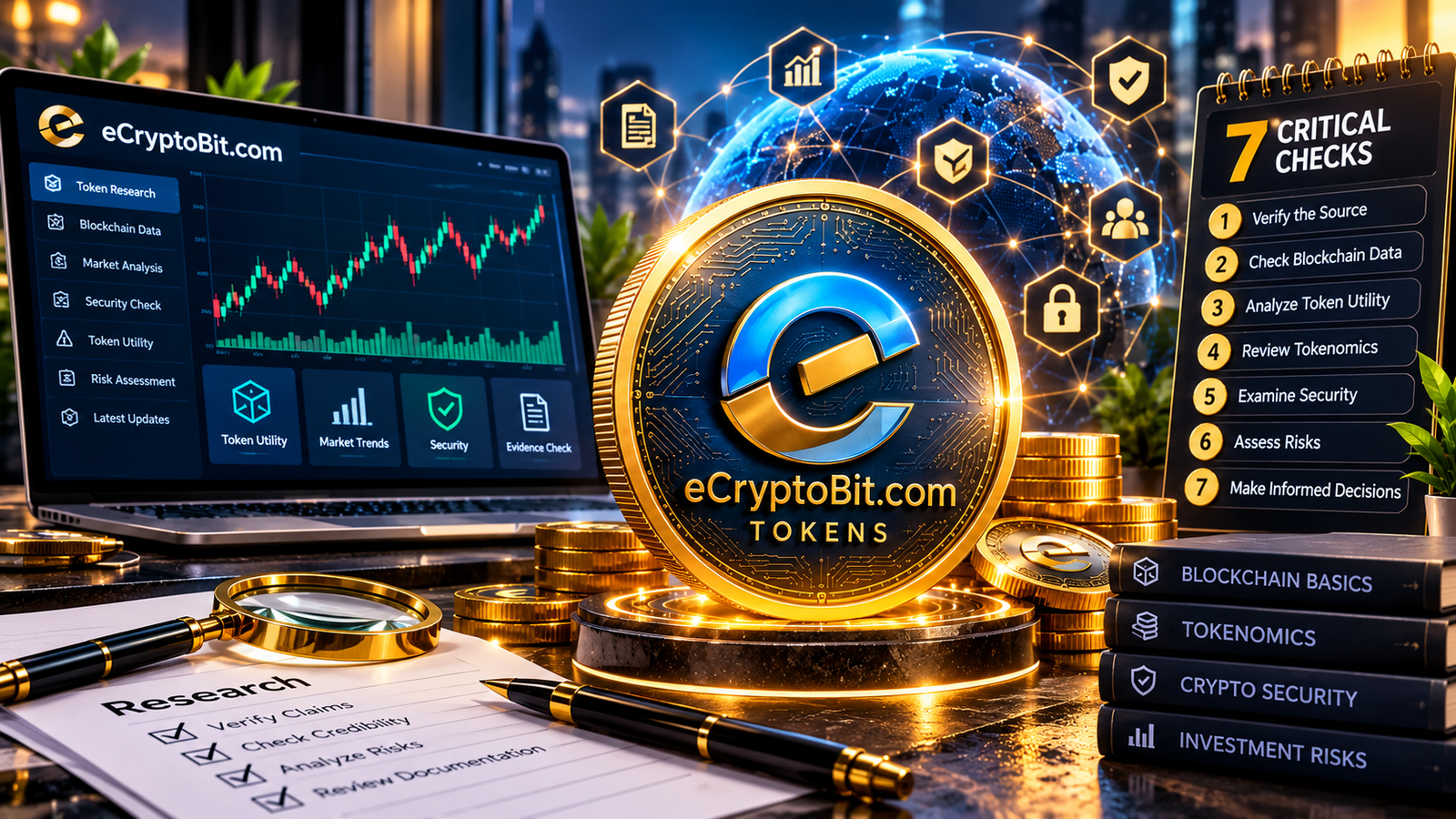
1The cryptocurrency industry continues to evolve as blockchain applications, digital assets, and decentralized platforms attract attention. However, the growing amount of online information makes it difficult to distinguish verified facts from promotional claims. A professional website or impressive project description does not automatically establish that a cryptocurrency is legitimate.
People searching for ecryptobit.com tokens may want to understand cryptocurrency education, investigate a possible digital asset, or learn how blockchain verification works. These goals require different types of evidence. A website can publish information about tokens without issuing its own cryptocurrency.
This article introduces seven practical checks for evaluating ecryptobit.com tokens, reviewing technical evidence, understanding token utility, and recognizing potential risks. Rather than relying on speculation, readers can use a structured research process to assess what is known, what remains uncertain, and which claims need further verification.
1. Establish the Identity of the Asset
The first step in researching ecryptobit.com tokens is to determine exactly what the phrase refers to. It might describe educational content, a third-party claim, or an alleged digital asset. These possibilities should not be treated as equivalent.
Identify the original source
Start with the official website and look for direct announcements, technical documentation, and clearly described products. When investigating ecryptobit.com tokens, distinguish between general cryptocurrency explanations and statements confirming the launch of a specific asset.
A third-party article may repeat a claim without independently verifying it. Therefore, trace important statements back to their original source before accepting them.
The official eCryptoBit website is a useful starting point for reviewing published information.
Record what remains unknown
When researching ecryptobit.com tokens, note whether the available material identifies an issuer, a blockchain network, or an official contract address. Missing information does not prove that a project is fraudulent, but it limits what can responsibly be concluded.
Avoid inventing token prices, supply figures, exchange listings, or platform features when reliable evidence is unavailable.
2. Create a Reliable Evidence Checklist
A claim becomes more useful when it can be tested against evidence. Use the following checklist when assessing ecryptobit.com tokens or any unfamiliar cryptocurrency.
- Existence: Is there an official announcement identifying the asset?
- Network: Does documentation specify the blockchain?
- Contract: Is a complete contract address available from a reliable source?
- Utility: Is the stated purpose explained in current documentation?
- Tokenomics: Are supply and distribution details published?
- Security: Is there a technical audit or other relevant review?
- Independent confirmation: Can important claims be checked against additional credible sources?
These checks help organize research into verifiable questions. They do not guarantee that an asset is safe or valuable.
For ecryptobit.com tokens, keep a record of each claim, the source supporting it, the date you checked it, and any missing evidence. This simple habit reduces the risk of confusing assumptions with established facts.
Read more: Meta Muse Spark Open: 7 Powerful AI Features Explained
3. Understand Blockchain Verification
Blockchain technology can provide public records of transactions and smart-contract activity. The information available depends on the network, but explorers may help users inspect addresses, transfers, token holders, and contract details.
Check the network first
A contract address is meaningful only in the context of its blockchain. Before evaluating ecryptobit.com tokens, identify the claimed network and locate the correct explorer. Never assume that an asset is genuine simply because its name resembles a familiar brand.
Examine contract information
Some explorers display contract source code, transaction history, and token-related information. These details can support technical research, but they cannot independently prove the identity of a project’s operators or guarantee its commercial success.
If someone claims that ecryptobit.com tokens have a particular contract, compare the complete address with official documentation rather than relying on a screenshot or social media post.
For additional technical background, consult the Ethereum developer documentation and the ERC-20 token standard. These resources explain blockchain technology and token interfaces; they do not confirm that a specific branded asset exists.
4. Evaluate Utility Beyond Marketing
A cryptocurrency token should have a clearly explained purpose if a project claims practical utility. Promotional statements alone are not enough to establish that a feature exists.
Access and payments
Some tokens are designed to pay for services or unlock digital features. To evaluate such a claim, check whether the service is available and whether the token is genuinely required.
Governance
Governance tokens may give holders voting rights over selected decisions. The real influence of those rights depends on the voting rules, distribution of power, and implementation process.
Rewards and staking
Some blockchain projects offer rewards for staking or participation. Such arrangements may include lock-up periods, variable returns, technical vulnerabilities, or changing conditions.
When examining ecryptobit.com tokens, treat these examples as general cryptocurrency concepts rather than confirmed platform features. Look for direct documentation before describing any particular utility as available.
5. Read Tokenomics Without Making Price Predictions
Tokenomics describes the economic structure of a digital asset, including supply, distribution, issuance, and incentives. These factors can help researchers understand a project, but they cannot reliably predict future prices.
Supply and circulation
Total supply and circulating supply may differ. Some assets reserve units for future release, while others permit additional issuance under defined rules.
If published figures for ecryptobit.com tokens are unavailable, do not estimate them or present unsupported numbers as facts. Record the source and date whenever you use supply data.
Distribution and concentration
Large holdings concentrated in a small number of wallets may influence liquidity and market behavior. However, wallet addresses can belong to exchanges, custodians, project treasuries, or smart contracts. Concentration needs context before conclusions are drawn.
Future token releases
Vesting schedules and planned releases can affect the amount of an asset available in the market. Researchers should check official documentation instead of guessing future issuance.
For ecryptobit.com tokens, any statement about supply, distribution, or unlock dates should be supported by verifiable information.
6. Investigate Security and Transparency
Security research should cover more than a website’s appearance. Consider technical reviews, contract permissions, governance arrangements, and the quality of public documentation.
Understand audit limitations
A security audit examines particular components within a defined scope. It may identify weaknesses, but it cannot guarantee that every part of a project is safe. An audit of one contract may not cover later code changes, websites, wallet integrations, or administrator credentials.
Review administrative permissions
Some contracts allow authorized parties to pause transactions, modify parameters, or manage token issuance. Such permissions are not automatically harmful, but users should understand how they work and who controls them.
When assessing ecryptobit.com tokens, distinguish between evidence about a specific contract and broad statements that a project is secure.
Look for transparent governance
Check whether documentation explains how decisions are made, who can approve changes, and whether users have meaningful participation. A project’s actual rules are more informative than a general claim that it is decentralized.
7. Recognize Financial and Security Risks
Cryptocurrency assets can be volatile, difficult to sell, and vulnerable to technical problems or fraud. Research should include the possibility that the safest decision is not to proceed.
Watch for misleading promises
Guaranteed returns, pressure to invest immediately, and claims that losses are impossible are serious warning signs. Popularity, attractive graphics, and positive comments do not prove that an investment is legitimate.
Protect wallet credentials
Never share a private key or recovery phrase with someone claiming to provide support. Check website addresses carefully, avoid suspicious links, and review transaction details before signing.
Consider liquidity
A quoted price does not guarantee that an asset can be sold at that price. Low trading volume, withdrawal restrictions, and network fees can make it difficult to exit a position.
Anyone researching ecryptobit.com tokens should verify the asset’s identity before interacting with a wallet, exchange, or token contract.
For additional consumer protection guidance, read the Federal Trade Commission’s cryptocurrency scam resources.
A Practical Research Workflow
Use this repeatable process when evaluating an unfamiliar digital asset:
- Define the exact claim you want to verify.
- Locate official documentation and primary sources.
- Confirm the network and contract address when applicable.
- Review utility, supply, governance, and security evidence.
- Record unanswered questions and avoid unsupported assumptions.
- Consider the financial consequences before taking action.
This process helps researchers assess ecryptobit.com tokens without confusing a published claim with independently verified evidence. If important information remains unavailable, the appropriate conclusion is that the claim has not been verified.
Read more: Almost All Top 100 Cryptocurrencies Solidly in Green, Dogecoin Skyrockets Over 40%
Frequently Asked Questions
What does ecryptobit.com tokens mean?
The phrase may refer to cryptocurrency-related educational content or claims about a digital asset associated with the eCryptoBit name. Its exact meaning should be established through official documentation.
Does eCryptoBit have a verified native token?
The information considered for this article does not clearly establish a native token with independently verified contract details and published tokenomics. Check current official sources before making a definitive statement.
How can I check a cryptocurrency contract?
Identify the blockchain network, obtain the full contract address from a reliable source, and compare it with the appropriate blockchain explorer. Similar names and symbols are not sufficient proof of identity.
Are staking rewards guaranteed?
No. Rewards may change, and staking may involve lock-up conditions, technical vulnerabilities, or financial losses. Review the terms carefully before participating.
What should beginners do when evidence is missing?
Avoid treating missing information as proof that a claim is true. Wait for verifiable documentation, compare credible sources, and never risk money needed for essential expenses.
Conclusion: Let Evidence Guide Your Decisions
Cryptocurrency research becomes more reliable when every important claim is matched to appropriate evidence. Official announcements, technical documentation, blockchain explorers, and independent reporting each provide different kinds of information.
The phrase ecryptobit.com tokens should not be treated as proof that a particular native asset exists or has a specific market value. First identify what the phrase refers to, then evaluate the available evidence about identity, utility, tokenomics, and security.
A disciplined research process is more valuable than a confident price prediction. Verify claims, protect wallet credentials, and make decisions only after understanding the available evidence and the risks involved.
