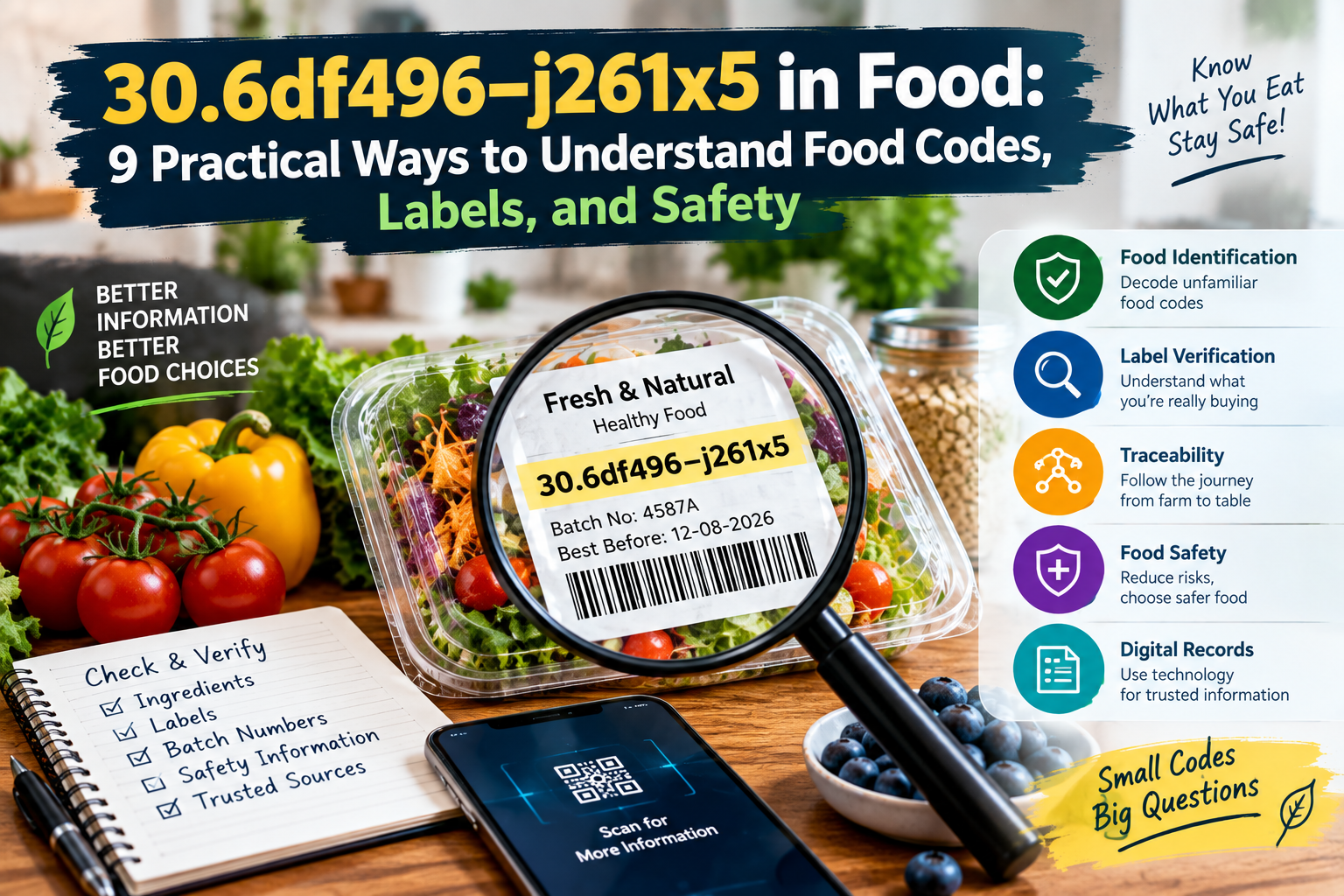
Introduction
Food products contain a growing amount of information, from ingredient lists and nutritional values to batch numbers, manufacturing dates, and digital identifiers. However, unfamiliar combinations of letters, numbers, and symbols can make it difficult for consumers to understand what a label actually means. The phrase 30.6df496–j261x5 in food raises an important question: how should people investigate an unfamiliar code without making assumptions about its purpose?
The first step is to examine the original source, the product category, and the surrounding information. A code alone does not prove that a product is safe, unsafe, approved, or suitable for consumption. This guide presents a practical framework for understanding unfamiliar food-related identifiers, checking product information, and making more informed decisions.
1. Understand the Difference Between a Code and an Ingredient
One common mistake is assuming that every unusual sequence printed on a package must identify an ingredient or chemical substance. In reality, food packaging can contain several kinds of identifiers, including batch references, internal inventory numbers, manufacturing codes, and product tracking information.
When researching 30.6df496–j261x5 in food, begin by determining whether the sequence appears on a physical package, a website, a database, or an online discussion. Its location provides useful context, but it does not establish its meaning by itself.
Look for nearby headings such as “batch number,” “lot number,” “ingredients,” or “product reference.” If the sequence appears in a digital record rather than on packaging, investigate the record’s publisher and purpose before drawing conclusions.
2. Examine the Original Source Before Trusting Online Claims
Search engines and social platforms can display explanations that are incomplete, copied from other websites, or disconnected from the original context. Repeated claims are not necessarily verified claims, particularly when several pages reproduce the same unsupported statement.
Anyone researching 30.6df496–j261x5 in food should first identify where the sequence originated. Check whether the information comes from a manufacturer, an official product document, a recognized standards organization, or an anonymous discussion.
Compare the wording across available sources. If a page claims that a code identifies a particular additive or hazard, look for a reliable document that directly supports that interpretation. When no trustworthy explanation is available, the most accurate conclusion is that the code remains unidentified.
3. Read Food Labels as a Complete Information System
A food label should be evaluated as a whole rather than through one isolated number or symbol. Depending on the product and applicable regulations, the package may identify ingredients, allergens, net quantity, nutritional information, manufacturer details, storage instructions, and relevant dates.
The context surrounding 30.6df496–j261x5 in food matters because nearby text may clarify whether the sequence relates to tracking, production, or another administrative purpose. However, proximity alone is not proof of a specific function.
Read the ingredient list separately from the manufacturing details. Check the product name, package condition, declared allergens, and storage requirements. If essential information is missing or illegible, contact the manufacturer or retailer instead of relying on an unexplained code.
4. Investigate Batch Numbers and Product Traceability
Batch and lot numbers help businesses distinguish one production group from another. When a quality problem is identified, traceability records may help manufacturers determine which products require investigation, withdrawal, or recall.
The appearance of 30.6df496–j261x5 in food does not automatically establish that the sequence is a batch number. That interpretation needs confirmation from the relevant manufacturer, label, or product documentation.
If you suspect that a code is connected to a batch, compare it with the format used elsewhere on the packaging. Contact the company through its official customer-support channel and provide the product name, purchase details, and a clear photograph of the label. This approach is more reliable than guessing from the sequence’s appearance.
Read more: CryptoProNetwork Com Adrian: 9 Fresh Perspectives for Smarter Crypto Research
5. Separate Food Safety Evidence From Speculation
Food safety decisions should rely on verifiable evidence, not frightening language or unsupported online warnings. An unfamiliar code does not, by itself, show that a product contains a dangerous substance or violates a safety standard.
When encountering 30.6df496–j261x5 in food, distinguish between a documented finding and a claim that has not been independently supported. Look for information from relevant food-safety authorities, product manufacturers, or qualified laboratories when a genuine safety concern exists.
If a product has an official recall notice, follow the instructions provided by the responsible authority or manufacturer. If the only evidence is a vague social media post, avoid presenting it as an established fact. Careful verification protects consumers from both unnecessary alarm and false reassurance.
6. Check Ingredients and Allergen Information Carefully
Ingredient verification is particularly important for people who need to avoid specific allergens or follow medically necessary dietary restrictions. The ingredient declaration, allergen statement, and manufacturer guidance are more useful for this purpose than an unexplained identifier.
If 30.6df496–j261x5 in food appears beside an ingredient list, do not assume that it names an ingredient. Check the complete label and consult the manufacturer for clarification. A code should not replace the information required to identify ingredients and allergens.
For packaged foods, review the current package rather than depending entirely on an older product listing online. Formulations and manufacturing arrangements can change. When an ingredient or allergen remains unclear, choose a product with information you can verify instead of making a potentially risky assumption.
7. Understand the Role of Digital Food Information
Modern food systems can use digital tools to manage stock, record shipments, monitor production, and provide product information. Barcodes, QR codes, databases, and internal software references may connect a physical product with electronic records.
Research into 30.6df496–j261x5 in food may therefore involve checking whether the phrase appears in a digital platform or technical document. Still, an unusual string should not be described as a recognized digital standard unless reliable documentation confirms that status.
When a package includes a QR code or web address, inspect the destination carefully. Prefer official company domains and established information sources. A digital record may offer helpful context, but its accuracy depends on who created it, how it is maintained, and whether it corresponds to the product being examined.
8. Use a Simple Verification Checklist
A consistent checklist helps prevent rushed conclusions when an unfamiliar code appears. Start by recording the exact sequence, including punctuation, capitalization, and any special characters. Small differences can lead to unrelated search results.
For 30.6df496–j261x5 in food, the next steps are to identify the source, review nearby text, search for manufacturer documentation, and compare any proposed explanation against independent evidence. Record what has been confirmed separately from what remains uncertain.
A useful checklist includes the product name, brand, country of sale, packaging details, source URL, publication date, and any official explanation. If the sequence cannot be verified, document that limitation clearly. A structured process is more dependable than treating the first search result as definitive proof.
9. Recognize Misleading Websites and Unreliable Advice
Some websites use technical-looking codes to attract visitors without providing meaningful evidence. Warning signs include dramatic claims without sources, copied paragraphs, unclear authorship, fabricated authority, and pressure to purchase a product or download an unfamiliar application.
When reading about 30.6df496–j261x5 in food, ask whether the website explains how it reached its conclusion. Does it link to original documentation? Does it distinguish confirmed information from speculation? Can the publisher and publication date be identified?
Avoid entering personal information or downloading files simply to discover the meaning of an unfamiliar code. A legitimate explanation should be supported by relevant evidence and should not require unnecessary access to your accounts, device, or payment details.
10. Know When to Contact a Manufacturer
Manufacturers and responsible distributors may have access to product specifications, packaging records, batch information, and internal identification systems that are not publicly available. Their clarification can be especially useful when an identifier is printed directly on a product.
If you cannot establish the meaning of 30.6df496–j261x5 in food, send the company a clear photograph and describe exactly where the sequence appears. Include the product name and relevant packaging details, but avoid sharing unnecessary personal information.
Ask a specific question: does the sequence identify a batch, a product reference, a production record, or something else? If the company cannot explain it, consider contacting the appropriate food-safety or consumer-protection authority in your region when the circumstances warrant further investigation.
11. Consider Storage, Expiry Dates, and Packaging Condition
Food safety depends on more than labels and identification systems. Storage conditions, expiry or best-before information, packaging integrity, and handling practices can all affect product quality and suitability.
The phrase 30.6df496–j261x5 in food should not distract consumers from these practical checks. An unfamiliar identifier cannot establish that a product has been stored correctly or that its contents remain safe to consume.
Follow the storage instructions printed on the package and pay attention to damaged seals, unusual leakage, and relevant date markings. Do not taste a product to test whether it is safe. If the packaging appears compromised or the product has been subject to an applicable recall, follow the appropriate safety guidance.
12. Understand the Limits of Automated Search Tools
Automated search systems can quickly locate matching text across websites, documents, and databases. However, a search result may match a sequence without explaining it accurately. Similar-looking identifiers can refer to completely different records.
A search for 30.6df496–j261x5 in food should therefore be treated as the beginning of an investigation rather than its conclusion. Examine the page itself, verify the publisher, and read the relevant passage instead of relying only on a search snippet.
Search the exact sequence first, then try carefully chosen variations only when necessary. Preserve the original spelling in your notes so that modified searches do not accidentally replace the identifier you are investigating. If results are irrelevant or contradictory, report the uncertainty rather than inventing a definition.
13. Build Better Consumer Information Habits
Good consumer research begins with clear questions. Instead of asking only what a code means, ask where it came from, which product it concerns, who published its explanation, and what evidence supports that explanation.
Using this method for 30.6df496–j261x5 in food encourages a more balanced approach to product information. It reduces the risk of confusing a technical reference with an ingredient, a warning, or a certification.
Keep records of official responses and reliable documents. When sharing findings with other people, explain which facts are confirmed and which points remain unresolved. This habit is useful for food research generally because it makes conclusions easier to check and correct when better information becomes available.
14. Apply the Same Standards to Online Food Articles
Articles about food technology, ingredients, and product identification should make their evidence easy to evaluate. Writers should explain unfamiliar terminology, link to relevant primary sources, and avoid presenting an unverified interpretation as a scientific discovery.
A responsible article mentioning 30.6df496–j261x5 in food should make the identifier’s uncertain status clear unless credible documentation establishes its meaning. It should also distinguish general food-label guidance from facts about a particular product.
Readers can assess an article by checking its references, author information, update date, and consistency with reliable sources. If a claim cannot be traced to supporting evidence, treat it cautiously. Clear sourcing improves understanding and helps prevent misinformation from spreading through repeated publication.
Read more: Understanding General and Civil Laws: The Foundation of a Just Society
15. Create a Repeatable Research Process
A repeatable process makes unfamiliar product identifiers easier to investigate without relying on intuition. First, copy the code exactly. Second, identify the product or document where it appears. Third, locate an official source. Fourth, compare the explanation with the visible label and relevant records. Finally, note any remaining gaps.
For 30.6df496–j261x5 in food, this sequence helps separate evidence from assumptions and keeps the research focused on the original question. If the identifier remains unexplained, there is no need to force a conclusion merely to complete the investigation.
The same process can be applied to packaging references, technical strings, inventory numbers, and other unfamiliar labels. Its main advantage is transparency: another person can review the sources, follow the steps, and understand why a conclusion was reached—or why no definitive conclusion is yet possible.
Conclusion: Make Evidence the Foundation of Food Decisions
Understanding unfamiliar identifiers requires patience, reliable sources, and attention to context. A sequence of letters and numbers may serve a technical or administrative purpose, but its appearance alone cannot establish its meaning, safety implications, or official status. Product labels, manufacturer documentation, and relevant food-safety guidance should remain central to the investigation.
Ultimately, researching 30.6df496–j261x5 in food is an opportunity to practise responsible information checking rather than make unsupported claims. By reviewing original sources, checking ingredients and dates, protecting personal information, and distinguishing facts from speculation, readers can make more informed decisions about packaged foods and digital product information.
Until a reliable source identifies the sequence, its specific meaning should remain unconfirmed. This cautious approach supports accurate research, responsible publishing, and better consumer awareness.
